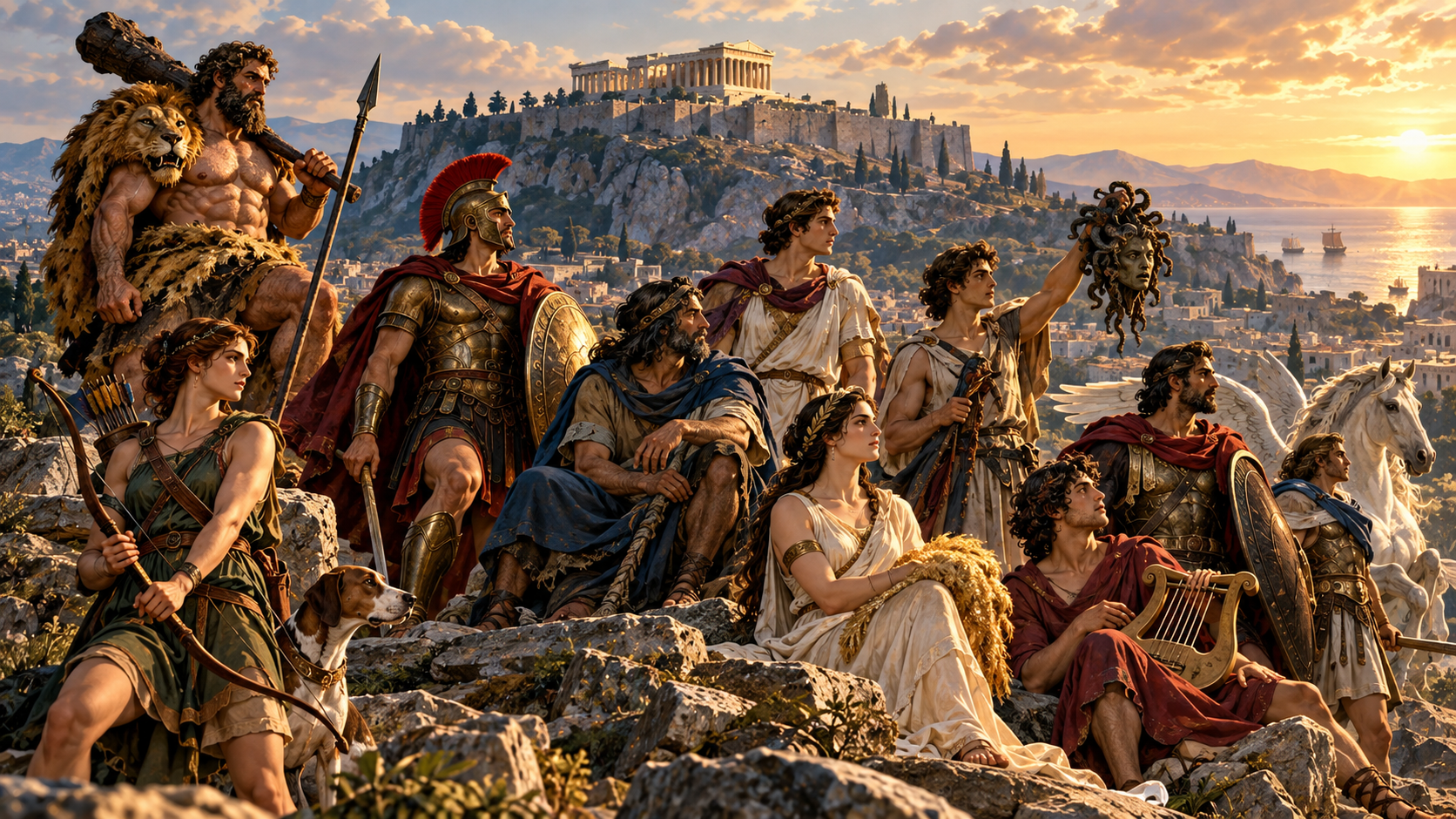
Greek mythology has no shortage of heroes. Heracles strangled monsters with his bare hands, Perseus killed Medusa, Theseus entered the Labyrinth, and Achilles chose glory over a long life. Odysseus, meanwhile, repeatedly survived situations that really should have killed him.
But Greek heroes weren’t superheroes in the modern sense, nor were they necessarily good people. They could be brave, clever and loyal, but also violent, arrogant and spectacularly self-destructive.
What united them was that they were exceptional. They killed monsters, founded cities, fought legendary wars and ventured into places ordinary mortals could not.
Here are some of the greatest heroes of Greek mythology, followed by a closer look at what being a hero actually meant to the ancient Greeks.
Meet the Heroes of Greek Mythology
There are far too many Greek heroes to include them all here, and different ancient traditions don’t always agree on their stories. Nevertheless, the figures below represent some of the most important heroes to emerge from Greek mythology.
Heracles
Better known today by his Roman name Hercules, Heracles was the son of Zeus and the mortal Alcmene. His extraordinary strength made him perhaps the greatest monster-slayer in Greek mythology, but his story is as much about suffering as physical power.
Hera’s hostility follows Heracles throughout his life. In the most famous version of his story, she drives him into a fit of madness in which he kills his own children. His subsequent servitude to King Eurystheus leads to the Twelve Labours, including killing the Nemean Lion and Hydra, capturing the Erymanthian Boar, stealing the apples of the Hesperides and bringing Cerberus up from the Underworld.
Even those adventures only cover part of his mythology. Heracles joins other expeditions, fights giants and kings, fathers numerous children and eventually suffers an agonising mortal death before being received among the gods on Olympus.
You can follow his most famous adventures in our guide to the Twelve Labours of Heracles.

Achilles
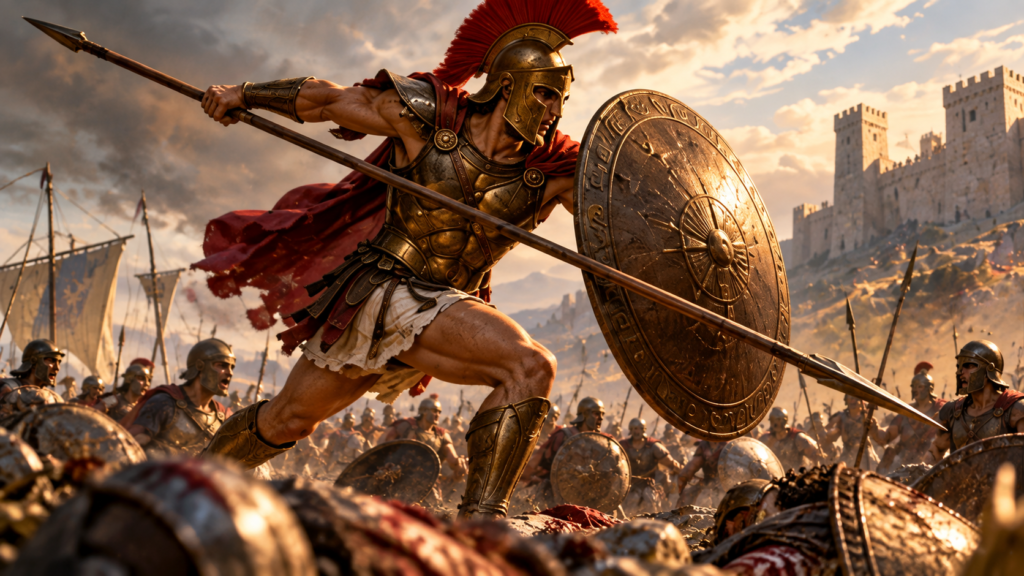
Achilles was the greatest warrior among the Greeks at Troy and the central heroic figure of Homer’s Iliad. Interestingly, the poem introduces him through his anger rather than his skill in battle.
His dispute with Agamemnon causes him to withdraw from the fighting, with disastrous consequences for the Greeks. When his companion Patroclus is killed by Hector, grief brings Achilles back into the war. He kills Hector and then, still consumed by rage, abuses the Trojan prince’s corpse until Hector’s elderly father Priam comes personally to beg for his son’s body.
That encounter gives Achilles considerably more depth than the almost invulnerable warrior of popular culture.
His famous vulnerable heel isn’t actually part of Homer’s account. The Iliad never says that Achilles was invulnerable, while the familiar story of Thetis dipping her son in the Styx developed in later tradition. The British Museum’s guide to Achilles gives a useful overview of how his story changed over time.
Achilles knows that remaining at Troy will bring him lasting glory at the cost of a short life. His decision to stay makes him one of Greek mythology’s clearest examples of the price of heroic fame.
Odysseus
If Achilles represents extraordinary ability in battle, Odysseus is celebrated above all for intelligence, adaptability and cunning.
King of Ithaca and one of the Greek leaders at Troy, he is credited in later accounts with devising the wooden horse that finally allows the Greeks to enter the city. Yet winning the war proves considerably easier than getting home.
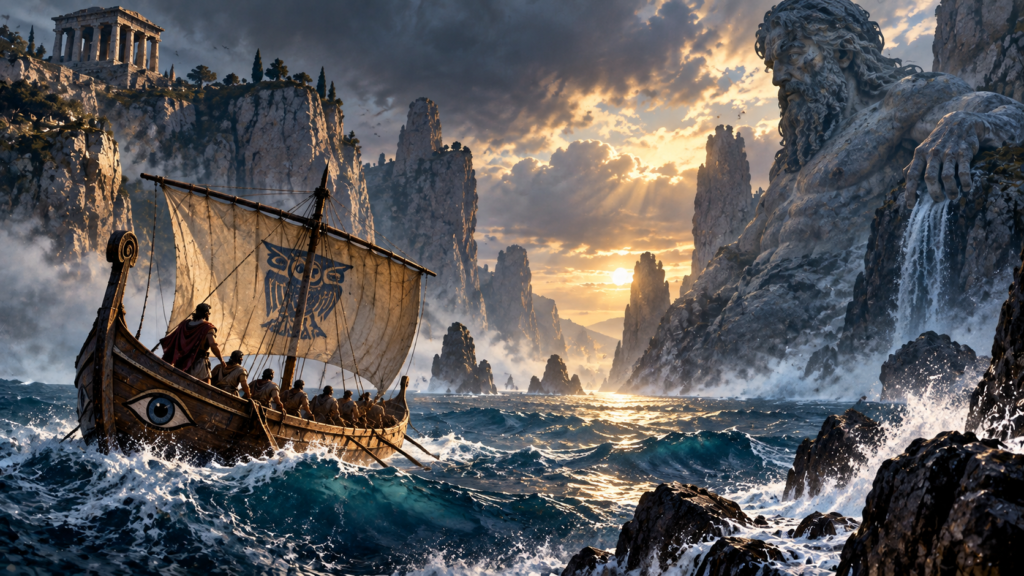
Homer’s Odyssey follows a return journey that lasts another ten years. Odysseus blinds the Cyclops Polyphemus but foolishly reveals his identity afterwards, earning the hatred of Polyphemus’ father Poseidon. He visits the island of the wind-god Aeolus, encounters the cannibalistic Laestrygonians, spends a year with Circe and travels to the edge of the Underworld to consult the dead prophet Tiresias.
He still isn’t finished. Odysseus hears the song of the Sirens while tied to his ship’s mast, navigates between Scylla and Charybdis, loses the remainder of his crew after they kill the cattle of Helios, and spends years detained on Calypso’s island before finally reaching Ithaca.
Even then, he arrives home in disguise and finds his palace filled with men competing to marry Penelope. His journey only truly ends after he kills the suitors and re-establishes himself in his household.
The British Museum’s overview of the Trojan War provides a useful introduction to Odysseus’ long return, while his stay with Circe is explored in our article on Circe and Odysseus.
Perseus
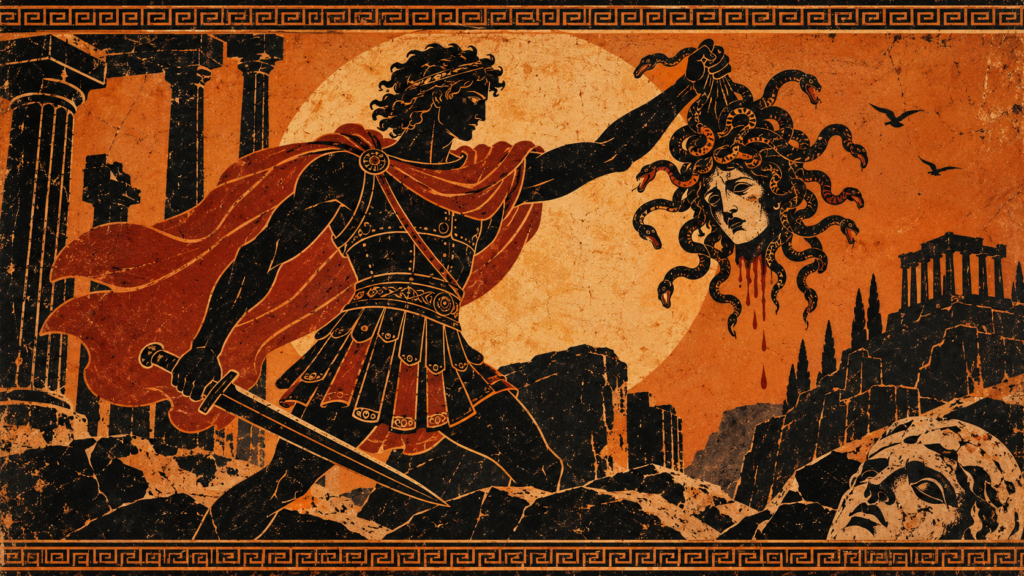
Perseus is one of the classic monster-slayers of Greek mythology, best known for killing Medusa.
The son of Zeus and Danaë, Perseus is sent to obtain the Gorgon’s head by King Polydectes, who has good reason to hope he won’t return. His success depends on more than bravery: the gods provide assistance and magical equipment, while Athena helps him avoid Medusa’s deadly gaze.
After killing her, Perseus escapes her immortal sisters and later encounters the Ethiopian princess Andromeda, who has been chained up as a sacrifice to a sea monster. He rescues her and eventually returns home with a weapon few enemies can answer: Medusa’s severed head.
You can read more about Medusa and her sisters in our guide to the three Gorgons of Greek mythology.
Perseus is also unusual among the major heroes because his later life is relatively successful. Greek mythology doesn’t always reward its heroes so generously.
Theseus
Theseus became the great hero of Athens, and his adventures helped connect the city’s mythical identity with the wider heroic world.
Before ever reaching Crete, he travels to Athens by a dangerous overland route and defeats a succession of violent opponents along the way. His most famous adventure comes later, when he volunteers to join the young Athenians sent as tribute to King Minos.
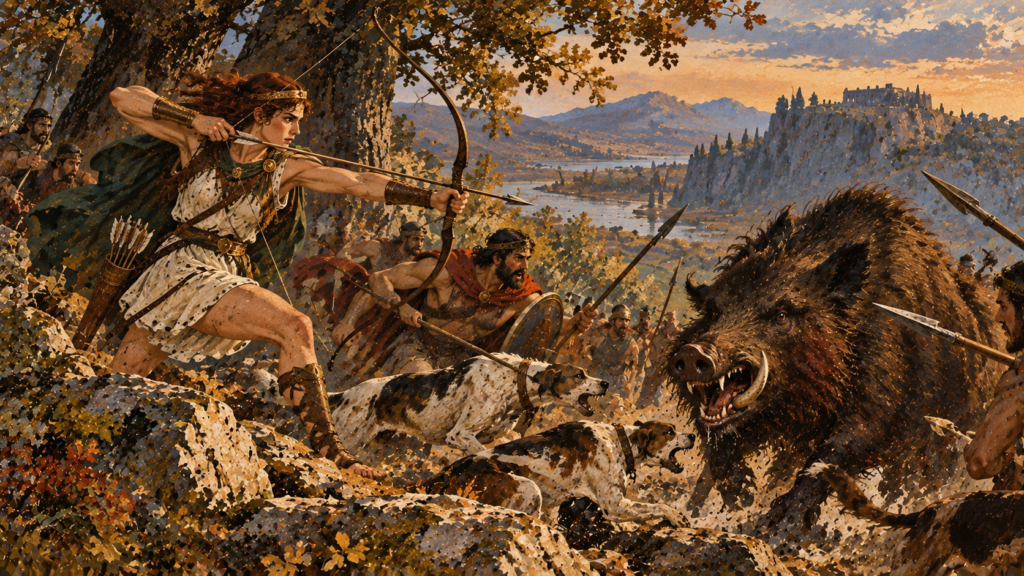
With the help of Minos’ daughter Ariadne, Theseus enters the Labyrinth, kills the Minotaur and uses her thread to find his way out. You can explore Theseus, Ariadne and the Minotaur further in our guide to Cretan mythology.
If his story ended there, Theseus would fit our modern idea of a hero reasonably well.
It doesn’t.
He abandons Ariadne, although ancient accounts differ over exactly why. Later stories include the tragic death of his son Hippolytus after Theseus calls down a curse upon him. More disturbing still is his partnership with Pirithous: the pair abduct the young Helen and then decide that they deserve daughters of Zeus as wives, leading them into the Underworld in an attempt to seize Persephone.
Unsurprisingly, Hades is not impressed.
Theseus therefore illustrates one of the most important things about Greek heroes. A man could kill monsters, protect a city and achieve legendary fame without being consistently admirable.
Jason
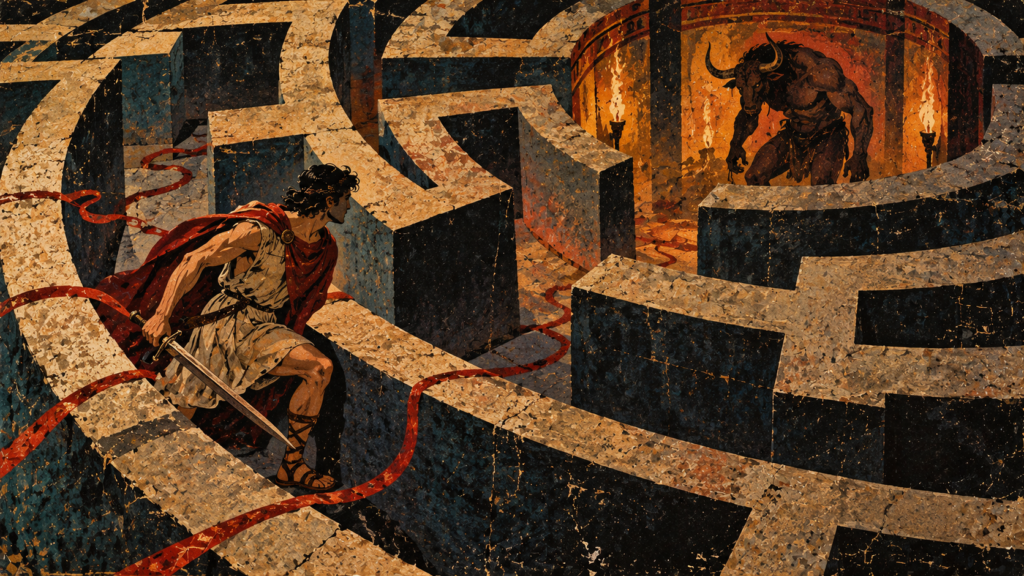
Jason led the Argonauts aboard the Argo on their voyage to Colchis in search of the Golden Fleece.
The expedition became something of an all-star gathering of Greek heroes. Different ancient authors provide different crew lists, but the Argonautic tradition brings Jason together with figures including Heracles, Orpheus, Castor, Pollux, Peleus and Meleager.
Jason reaches Colchis only to be confronted with seemingly impossible tasks by King Aeëtes. His survival and eventual possession of the Fleece depend heavily on the king’s daughter Medea, who falls in love with him and uses her magical knowledge to help him.
This complicates Jason’s heroic reputation. He leads the expedition and completes the quest, but he could not have done so without Medea, whom he later abandons in favour of a politically advantageous marriage.
Euripides’ Medea turns the consequences into one of Greek tragedy’s most disturbing stories. Our article on why Medea killed her children explores what follows.
Jason wins one of Greek mythology’s greatest prizes. Whether he emerges from the whole story looking particularly heroic is another question.
Bellerophon
Bellerophon is sometimes overshadowed by Heracles and Perseus, but his mythology contains almost everything we might expect from a Greek hero.
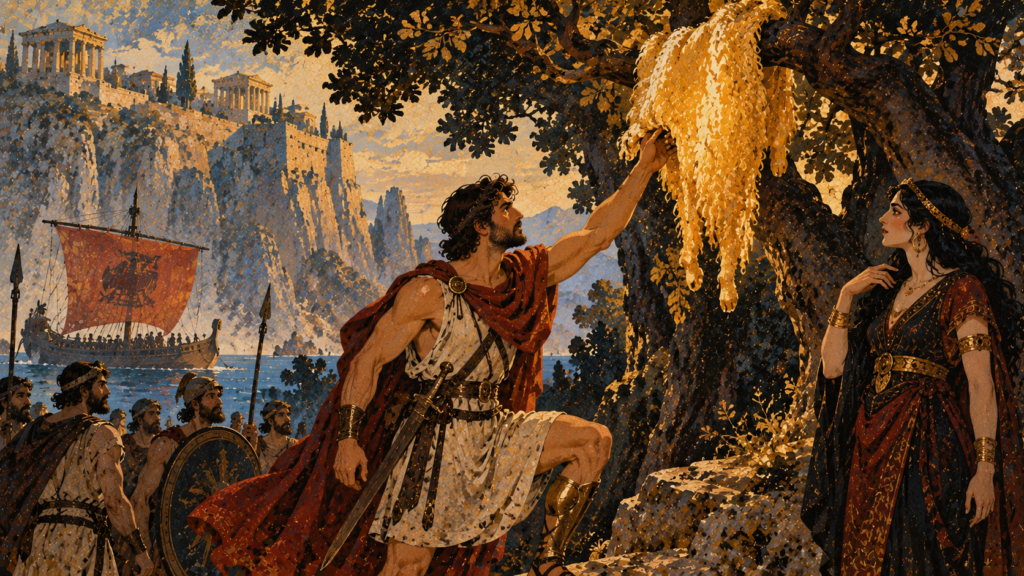
After being falsely accused of attempting to seduce another man’s wife, he is sent to Lycia carrying a sealed message that effectively requests his own death. Rather than kill a guest directly, the Lycian king sends Bellerophon against the Chimera, a monstrous creature that breathes fire and combines features of several animals.
Bellerophon kills it, traditionally with the aid of the winged horse Pegasus, and survives further deadly tasks intended to finish him off. His victories eventually earn him recognition rather than death.
Later tradition, however, gives his story a very Greek reversal. Having achieved extraordinary things, Bellerophon attempts to fly Pegasus to Olympus itself. The journey ends in a fall, and the once-celebrated hero spends his remaining life in isolation.
His story moves from persecution to greatness and then from greatness to overreach, which makes the Chimera only part of what makes Bellerophon interesting.
Atalanta
Greek heroic mythology is overwhelmingly populated by men, but not exclusively so.
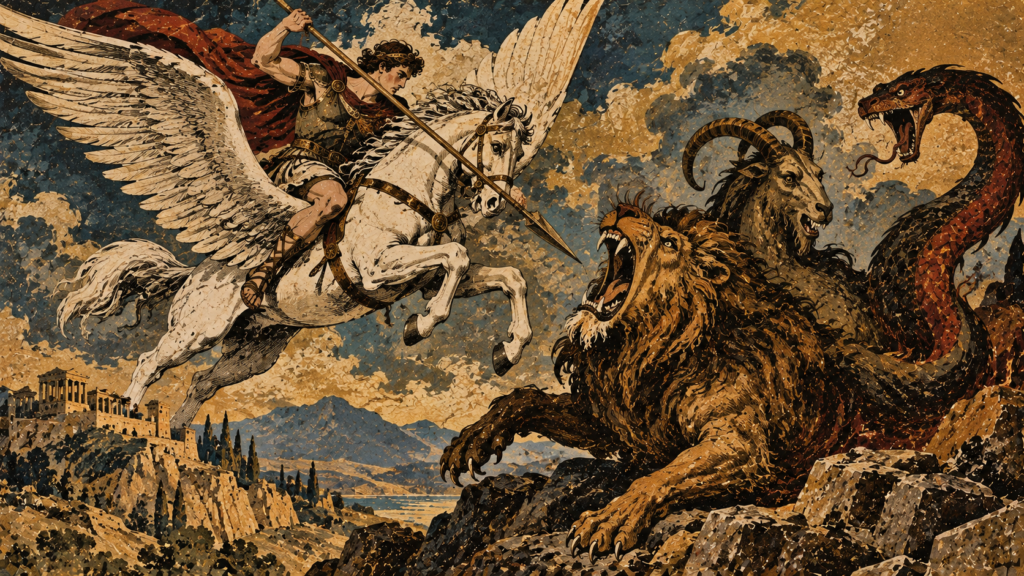
Atalanta was a formidable hunter and athlete whose stories repeatedly place her in roles normally occupied by male heroes. Her most famous adventure is the Calydonian Boar Hunt, where a group of warriors gathers to destroy the enormous animal sent to ravage the region. Atalanta is the first hunter to wound it, and Meleager later awards her its hide.
She is also associated with the Argonauts, although ancient traditions disagree over whether she actually sailed with Jason. That disagreement is worth preserving rather than forcing Greek mythology into a single consistent version.
Atalanta’s other famous story concerns marriage. Determined not to marry unless a suitor can defeat her in a footrace, she outruns a succession of challengers until Hippomenes — or Melanion in some versions — receives divine help in the form of golden apples. By dropping them during the race, he distracts Atalanta long enough to win.
Whether hunting, wrestling or racing, Atalanta’s stories make her exceptional for the same basic reason as the male heroes around her: she can do things ordinary people cannot.
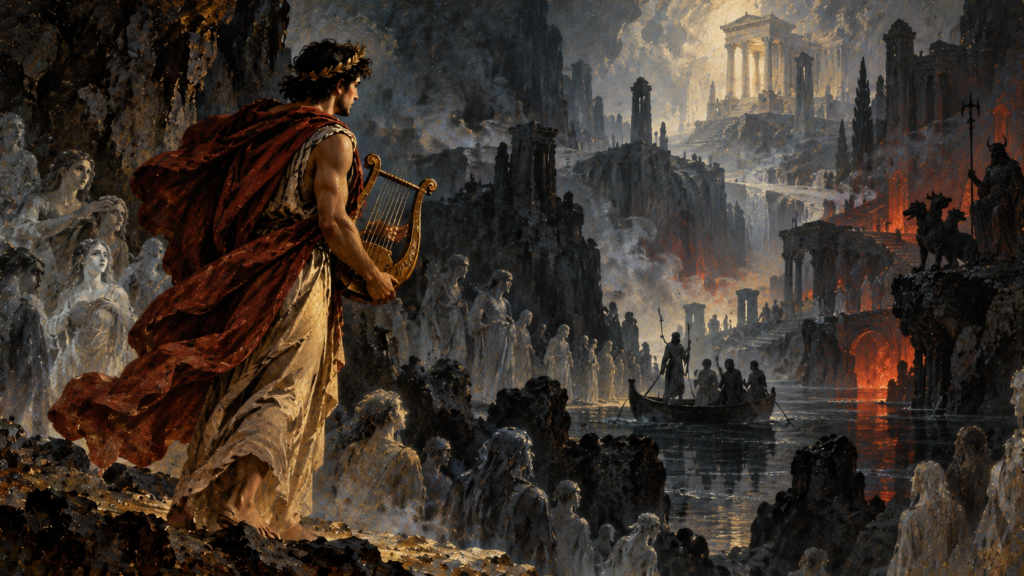
Orpheus
Orpheus is unusual because his defining ability isn’t strength or skill with a weapon. It’s music.
His singing and lyre-playing could enchant animals, trees and even stones. He also joins the Argonautic expedition in many traditions, where his music proves useful in ways that brute force cannot.
His defining myth begins after the death of his wife Eurydice. Orpheus travels into the Underworld and uses his music to move Hades and Persephone themselves. They agree that Eurydice may return with him on one condition: Orpheus must not look back at her until they have left the realm of the dead.
Near the end of the journey, he does.
Eurydice is lost a second time.
The story still follows a familiar heroic pattern — a mortal crosses into a realm beyond ordinary human reach — but Orpheus does so through art rather than violence. His failure also gives the story its power. He gets astonishingly close to overcoming death, but close isn’t enough.
Hector
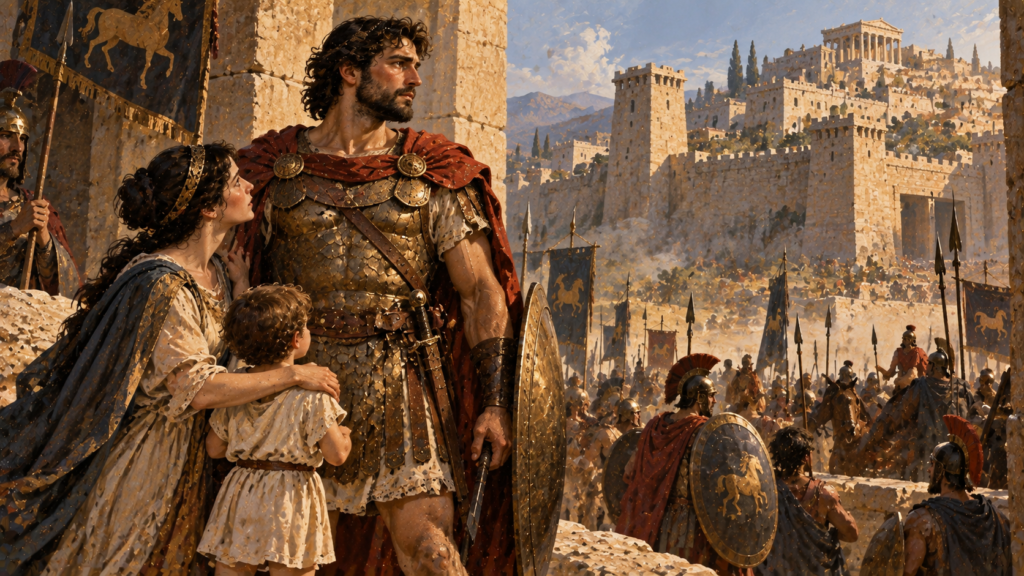
Hector raises an interesting question because he fights against the Greeks at Troy, yet he is unquestionably one of the great heroic figures preserved by Greek literature.
The eldest son of Priam and Troy’s foremost defender, Hector has responsibilities that distinguish him from many of the Greek warriors. He has a city to defend, parents who fear for him, and a wife and young son waiting inside Troy.
Homer allows us to see all of this. Hector can be courageous without being fearless, and his famous meeting with Andromache and their son gives the Iliad one of its most intimate scenes.
Eventually he faces Achilles outside the walls of Troy and is killed. Achilles initially refuses to return his body and repeatedly drags it behind his chariot, until Priam enters the Greek camp and begs the killer of his son for its return. The episode brings Achilles and Hector’s story together one final time and closes the Iliad not with the fall of Troy, but with Hector’s funeral.
The Greeks preserved a Trojan enemy as one of mythology’s most sympathetic heroes. That alone should warn us against treating these stories as a simple contest between heroes and villains.
Cadmus
Cadmus doesn’t fit quite as neatly into the familiar mould of the wandering monster-slayer, but he belongs firmly within the wider Greek heroic tradition.
His story begins with the disappearance of his sister Europa. While searching for her, Cadmus is eventually instructed by an oracle to abandon the quest and follow a cow until it lies down, establishing a city at that spot.
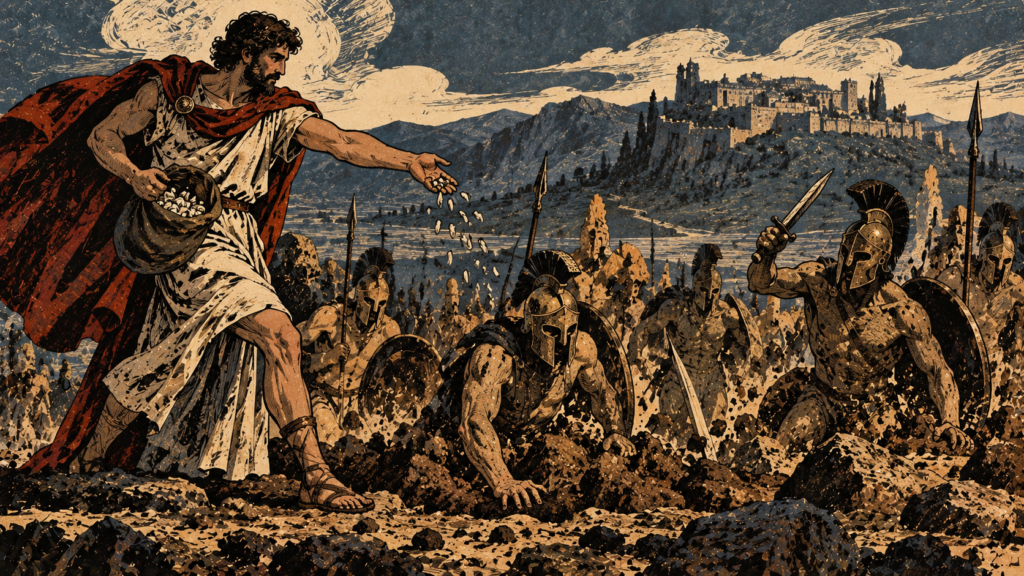
Before he can do so, he encounters and kills a dragon sacred to Ares. On Athena’s advice he sows its teeth into the earth, from which armed warriors known as the Spartoi emerge. The survivors become associated with the foundation of Thebes.
Cadmus therefore combines several heroic roles: traveller, monster-slayer and, most importantly, founder. His mythology links heroic adventure with the imagined origins of one of Greece’s great cities.
His later life is no simple happily-ever-after either. His family becomes one of the most catastrophe-prone dynasties in Greek mythology.
We explore the full story in our article on Cadmus and the founding of Thebes.
What Was a Greek Hero?
Calling somebody a hero today usually involves a moral judgement. We tend to mean that a person is brave, admirable or selfless, but that definition doesn’t transfer neatly to ancient Greece.
Mythological heroes were exceptional mortals, often with divine ancestry, whose achievements placed them outside ordinary human experience. Strength, courage, intelligence, noble birth and extraordinary deeds could all contribute to heroic status. Good behaviour was another matter entirely.
There was also a religious dimension that modern retellings often overlook. Heroes could receive cult worship after death, sometimes centred upon a tomb or heroon. A late fourth-century BCE marble relief in the Metropolitan Museum depicts worshippers approaching a reclining hero; the museum describes sacrifices, libations and ritual meals associated with such cults. View the Greek hero relief at the Metropolitan Museum of Art
The Greek hero therefore occupied an unusual position. He or she remained distinct from the Olympian gods, but could become something more than an ordinary dead mortal.
Monsters and Quests
One of the most recognisable heroic patterns involves sending somebody to accomplish something that ought to be impossible: kill Medusa, destroy the Hydra, enter the Labyrinth, defeat the Chimera or retrieve the Golden Fleece. Quite often, whoever assigns the task would be perfectly happy if the hero never returned.
Yet these stories are rarely about brute strength alone. Perseus requires divine assistance, Theseus needs Ariadne’s thread and Jason depends heavily on Medea. Even Heracles receives help during some of his Labours.
What these heroes repeatedly do is cross boundaries. They travel beyond familiar territory, enter forbidden spaces, confront creatures outside the normal human world and occasionally descend into the realm of the dead itself.
The monster matters, but so does going somewhere ordinary humans cannot — and returning afterwards.
Heroes of Troy
The Trojan War presents a different heroic world. Here the great opponent is usually another human being with a family, reputation and heroic claim of his own.
Achilles, Hector, Ajax, Diomedes and Odysseus inhabit a culture in which courage, honour and reputation matter enormously. The concept of kleos — fame or glory that survives death — is particularly important.
Achilles confronts the cost directly. The Iliad gives him a choice between returning home to a long life without lasting glory or remaining at Troy and gaining immortal fame at the price of dying young.
Homer never lets that glory become uncomplicated. Achilles’ pursuit of honour brings rage and grief, while Hector’s courage cannot save either himself or Troy. Odysseus provides another perspective entirely: after surviving the war that made him famous, he spends another ten years desperately trying to return to his wife, son and home.
Heroic glory could be magnificent, but Greek mythology rarely pretends it was free.
Beyond the Battlefield
Not every hero fits comfortably into the roles of monster-slayer or battlefield champion.
Jason’s defining achievement is a voyage. Atalanta enters heroic mythology through hunting and athletic ability, while Orpheus’ greatest gift is artistic. Cadmus becomes important not merely because he kills a dragon, but because he founds a city.
Even among the more conventional warriors there is no single model of excellence. Heracles has extraordinary strength, Odysseus cunning and adaptability, Achilles martial brilliance, and Hector a powerful sense of responsibility towards Troy and his family.
Greek heroic tradition had room for different kinds of exceptional people. What mattered was not that every hero possessed the same qualities, but that they stood apart from ordinary human experience.
Why Heroes Fall
For all their victories, Greek heroes have a remarkable tendency to end up dead, miserable or both.
Heracles completes his Labours but later suffers an agonising death before his apotheosis. Achilles gains the lasting fame of Troy at the cost of a short life. Jason wins the Golden Fleece only for his relationship with Medea to collapse catastrophically, while Bellerophon rises from condemned exile to celebrated monster-slayer and then falls from greatness.
Their suffering isn’t an awkward epilogue to the heroic story. In many cases, it’s fundamental to it.
Extraordinary ability doesn’t exempt these characters from grief, mistakes or death. Sometimes the qualities that make them exceptional also contribute to their downfall: Achilles’ fierce sense of honour fuels his rage, Bellerophon’s success feeds his ambition, and Odysseus’ pride in his cleverness earns him the lasting anger of Poseidon.
That is part of what makes Greek heroes more interesting than a parade of invincible champions.
The Greeks didn’t need their heroes to be perfect. They needed them to be worth remembering.
Get in Touch
Who is your favourite hero from Greek mythology? Is there a hero you’d particularly like to see covered in more detail?
I’d love to hear from you. You can contact me at richard@mythologyplanet.com.