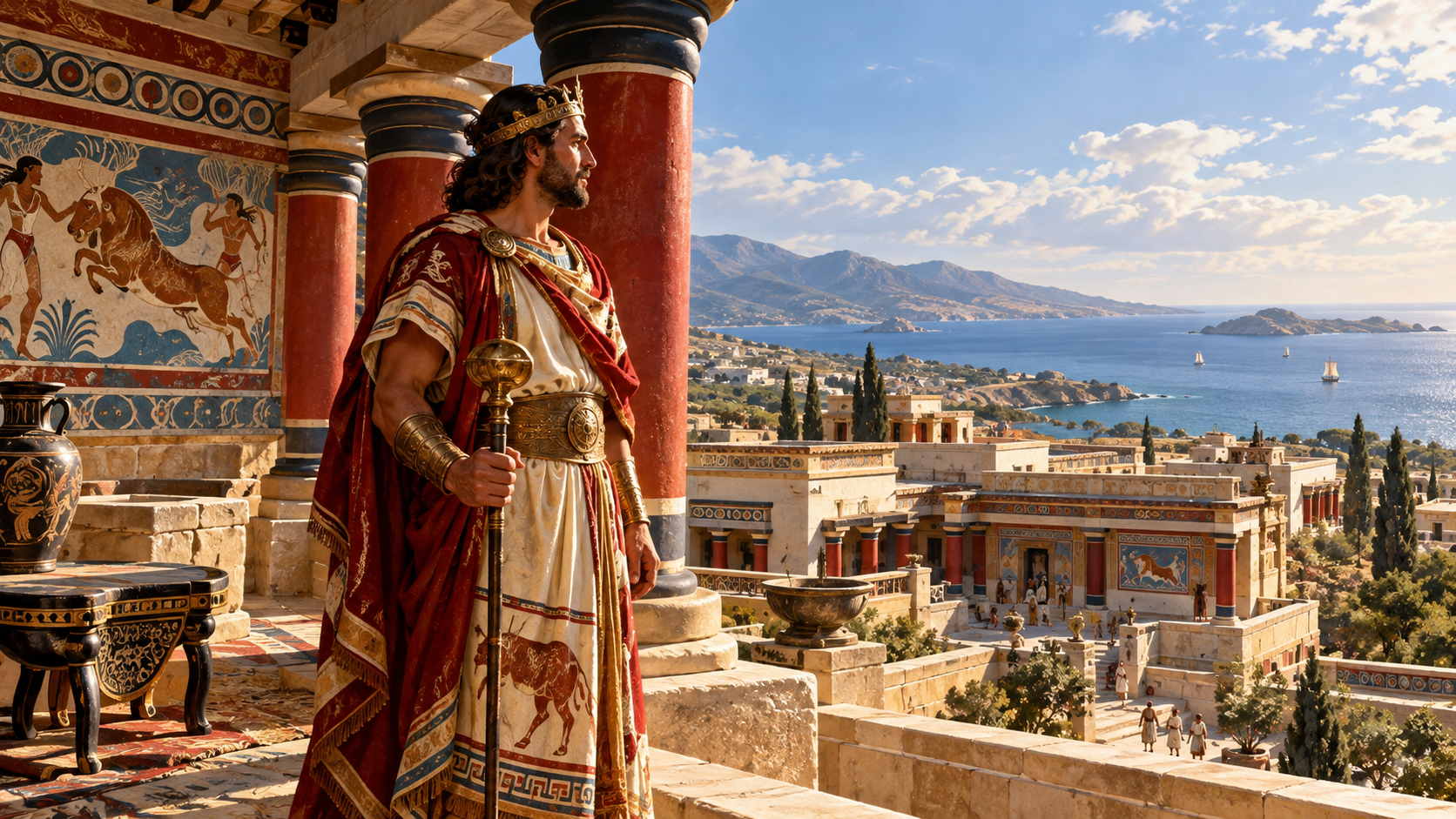
King Minos was one of the most powerful rulers in Greek mythology, governing the island of Crete and its magnificent palace at Knossos. He is best remembered for imprisoning the Minotaur in a labyrinth and demanding human sacrifices from Athens, but his story also involves divine punishment, the ingenious Daedalus and a rather unusual death.
In ancient Greek traditions, Minos was both a feared tyrant and a respected lawgiver. His reputation was complicated enough that he eventually became one of the judges of the dead.
Who Was King Minos?
Minos was a legendary king of Crete, traditionally described as the son of Zeus and Europa. His brothers included Rhadamanthus and Sarpedon, while his wife was Pasiphaë, daughter of the sun god Helios.
He was associated with the great palace at Knossos and the maritime power of ancient Crete. Some Greek traditions portray him as a wise lawgiver who received guidance from Zeus, while others, particularly those connected with Athens, describe a ruthless ruler who demanded terrible sacrifices from his enemies.
These contrasting accounts make Minos one of Greek mythology’s more complicated kings. He also appears alongside several other legendary figures in our guide to Cretan mythology.
The Bull of Poseidon and the Birth of the Minotaur
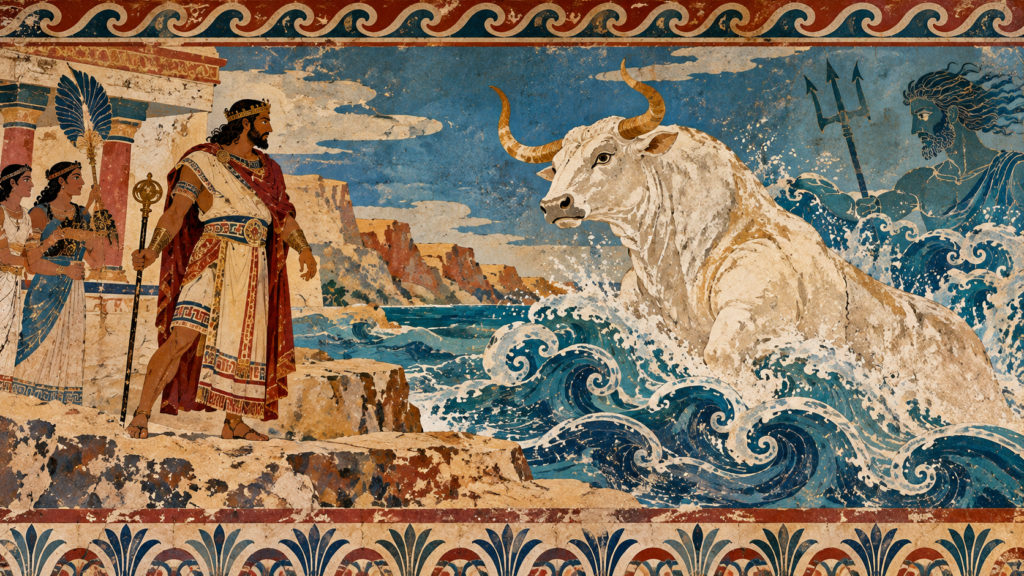
According to the Bibliotheca, attributed to Apollodorus, Minos faced opposition when he attempted to claim the Cretan throne. To demonstrate that the gods supported him, he prayed to Poseidon for a magnificent bull to emerge from the sea, promising to sacrifice it in the god’s honour.
Poseidon granted his request, but Minos was so impressed by the animal that he kept it and sacrificed another bull instead. Angered by the deception, Poseidon caused the bull to become savage and Pasiphaë to develop an unnatural passion for it.
With the help of the craftsman Daedalus, who constructed a hollow wooden cow, Pasiphaë conceived a monstrous child called Asterius, better known as the Minotaur. The creature had the body of a man and the head of a bull.
Minos ordered Daedalus to build an elaborate labyrinth to contain the creature. Its twisting passages made escape almost impossible.
The circumstances surrounding Pasiphaë and the bull are among the strangest episodes in Greek mythology. The ancient account can also be found in Apollodorus’s Bibliotheca, Book 3.
Theseus and the Labyrinth
Minos’s troubles soon extended beyond Crete. His son Androgeus died in circumstances connected with Athens, prompting Minos to wage war against the city. He eventually demanded a dreadful tribute: seven young men and seven young women to be sent to Crete and given to the Minotaur. Ancient accounts differ on how frequently this tribute was collected.
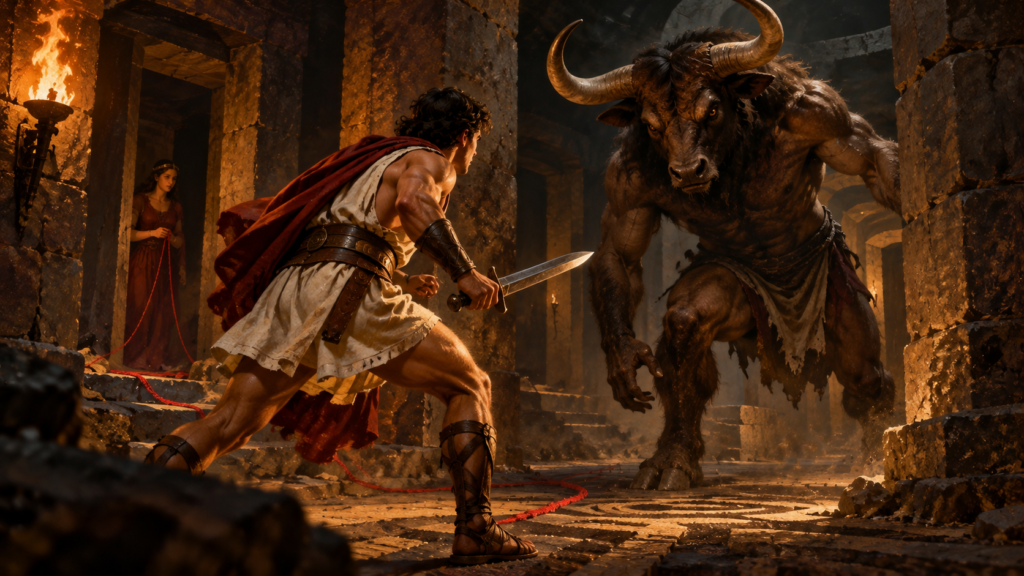
The Greek hero Theseus volunteered to join the victims, determined to kill the creature. On Crete, Minos’s daughter Ariadne fell in love with him and helped him navigate the labyrinth. In a famous version of the story, she provided a thread that Theseus could unwind as he entered the maze.
Theseus killed the Minotaur and followed the thread back to safety, escaping with Ariadne. Minos had lost his fearsome prisoner, his tribute from Athens and the loyalty of his own daughter.
He subsequently turned his anger towards Daedalus, whose ingenuity had made the escape possible.
The Strange Death of King Minos
After Theseus escaped, Minos imprisoned Daedalus and his son Icarus. The craftsman fashioned wings that allowed them to flee Crete, although Icarus famously died after flying too close to the sun.
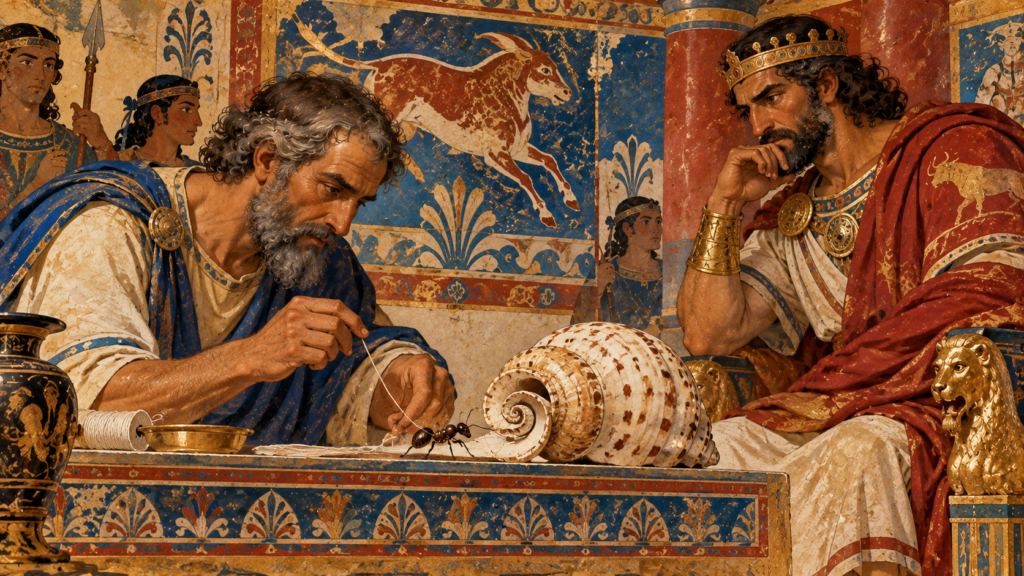
Daedalus eventually reached Sicily, where he found protection at the court of King Cocalus. Minos pursued him, carrying a spiral seashell and offering a reward to anyone who could pass a thread through it. He knew that only someone as ingenious as Daedalus would solve the puzzle.
Cocalus secretly gave the shell to Daedalus, who attached the thread to an ant and guided it through the winding passage. Minos recognised the trick and demanded the craftsman’s surrender.
But Cocalus’s daughters intervened. According to one account, they killed Minos while he was bathing, with some versions describing boiling water being poured over him.
The ruler who had survived wars and monsters met his end in a bath.
This episode appears in Apollodorus’s Epitome.
Minos as a Judge of the Dead
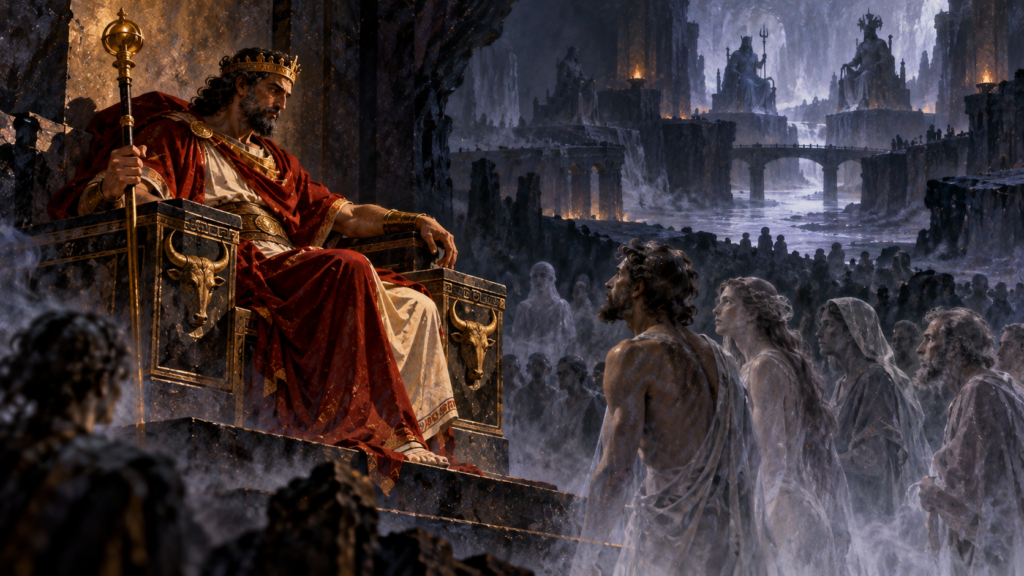
Despite his often brutal behaviour, Minos became a judge of the dead in Greek mythology. In Homer’s Odyssey, Odysseus encounters him in the underworld, holding a golden sceptre and passing judgement among the spirits.
Later traditions frequently place him alongside Rhadamanthus and Aeacus, two other judges who assess the dead. This role reflects the contrasting ways ancient Greeks remembered Minos: as both a tyrant and a ruler associated with justice and divine authority.
The judgement of souls was an important aspect of the Greek underworld, while Theoi’s guide to Rhadamanthus explores the traditions surrounding Minos’s fellow judge.
Minos remains a fascinatingly contradictory figure. He was favoured by the gods, punished for his arrogance, feared by his enemies and ultimately entrusted with judging the dead.
Get in Touch
What do you think of King Minos? Was he a capable ruler undone by arrogance, or a tyrant who deserved his downfall?
Leave a comment below, or contact me at richard@mythologyplanet.com.