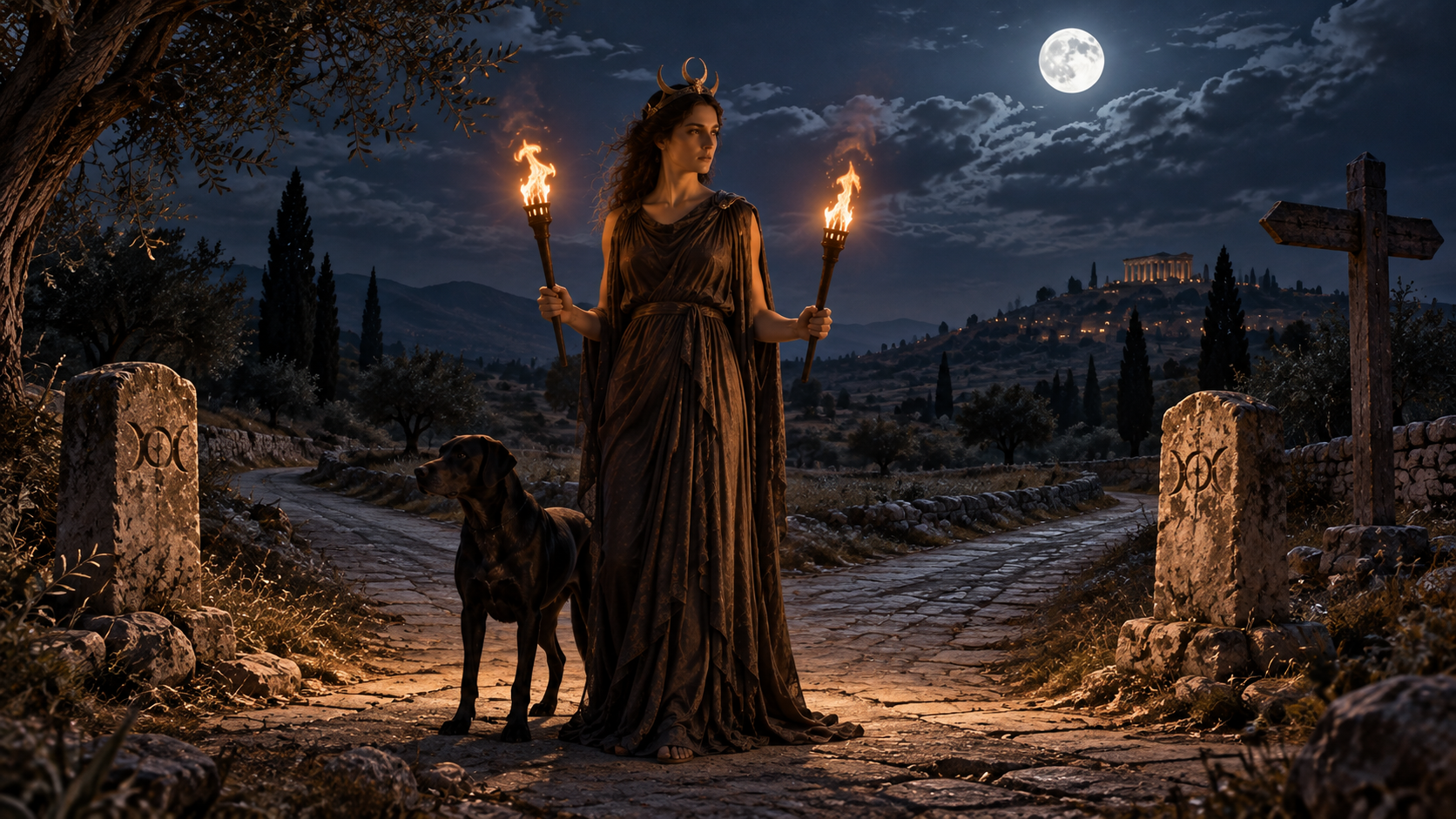
Hecate is one of the most mysterious goddesses in Greek mythology.
Today, she is best known as the goddess of witchcraft, magic, ghosts, night and crossroads. She is often depicted carrying torches, accompanied by dogs or appearing in three forms.
But the earliest Greek accounts present a surprisingly different Hecate.
In Hesiod, she is a powerful and respected goddess whose influence extends across the earth, sea and heavens. Her darker associations with witchcraft and the dead became more prominent over time.
So who was Hecate, and how did she become one of Greek mythology’s most enduring goddesses?
Who Was Hecate in Greek Mythology?
Hecate was a Greek goddess associated with crossroads, boundaries, magic, ghosts and the night.
Unlike many Olympian gods, she did not fit neatly into one area of divine responsibility. She could protect households and travellers, assist in childbirth and prosperity, and later became closely associated with witchcraft and the supernatural.
This ability to move between different worlds became central to her identity.
Hecate also survived the rise of Zeus unusually well. Although descended from the older generation of Titans, she retained her divine privileges after Zeus took power.
Who Were Hecate’s Parents?
According to Hesiod’s Theogony, Hecate was the daughter of the Titans Perses and Asteria.
Asteria was associated with the stars and night, while Perses was a son of the Titans Crius and Eurybia.
This makes Hecate a member of the older divine generation that preceded the Olympians.
Yet Zeus did not strip Hecate of her powers. Hesiod instead says that he honoured her above all and allowed her to retain the privileges she had possessed before his reign.
You can read Hesiod’s account in the Perseus Digital Library edition of the Theogony.
Was Hecate Originally a Goddess of Witchcraft?
Not primarily.
Hesiod’s Hecate is far broader than the sinister goddess of magic familiar from later tradition.
In the Theogony, her influence extends across earth, sea and the starry heavens. She can grant wealth and success, aid warriors and athletes, assist fishermen and increase livestock.
She is also associated with the nurturing of children.
This is one of the most interesting things about Hecate: her earliest surviving literary portrait is remarkably positive.
Her strong connections with witchcraft, ghosts and the Underworld developed more clearly in later Greek and Roman tradition.
This evolution also helps explain why Hecate is often included among the chthonic deities of Greek mythology, even though Hesiod does not present her simply as an Underworld goddess.
Hecate and Persephone
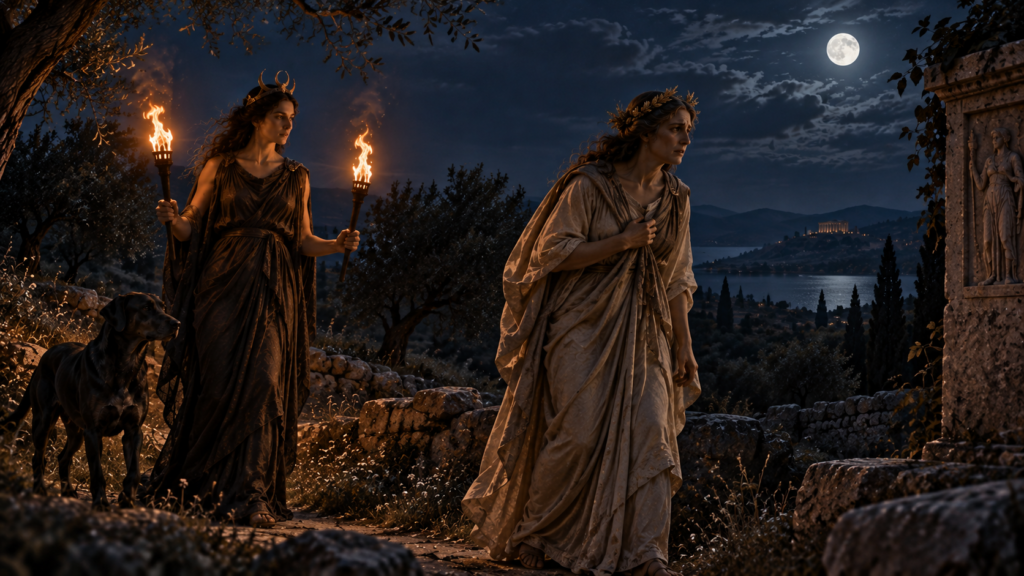
One of Hecate’s most important mythological appearances occurs in the story of Demeter and Persephone.
When Hades abducts Persephone, her cries are heard by Hecate.
Hecate does not see the abduction itself, so she cannot tell Demeter who has taken her daughter. Instead, she approaches Demeter carrying a torch and accompanies her to question Helios, the sun god who sees everything from the sky.
After Persephone eventually returns from the Underworld, Hecate becomes her companion.
The story helps explain several of Hecate’s later characteristics. She carries torches through darkness, assists someone travelling between worlds and becomes connected with a goddess who moves repeatedly between the living world and the Underworld.
The Homeric Hymn to Demeter can be read through the Perseus Digital Library.
Why Was Hecate Associated With Crossroads?
Hecate became particularly associated with crossroads, doorways and boundaries.
These are all liminal places: points where one space ends and another begins.
For Hecate, that was particularly appropriate. She occupied boundaries between the divine and human worlds, between safety and danger and, increasingly, between the living and the dead.
Shrines and images of Hecate could therefore be placed at crossroads and entrances.
Three-way crossroads were especially associated with her and probably contributed to the development of her famous triple form.
Hecate’s Three Forms
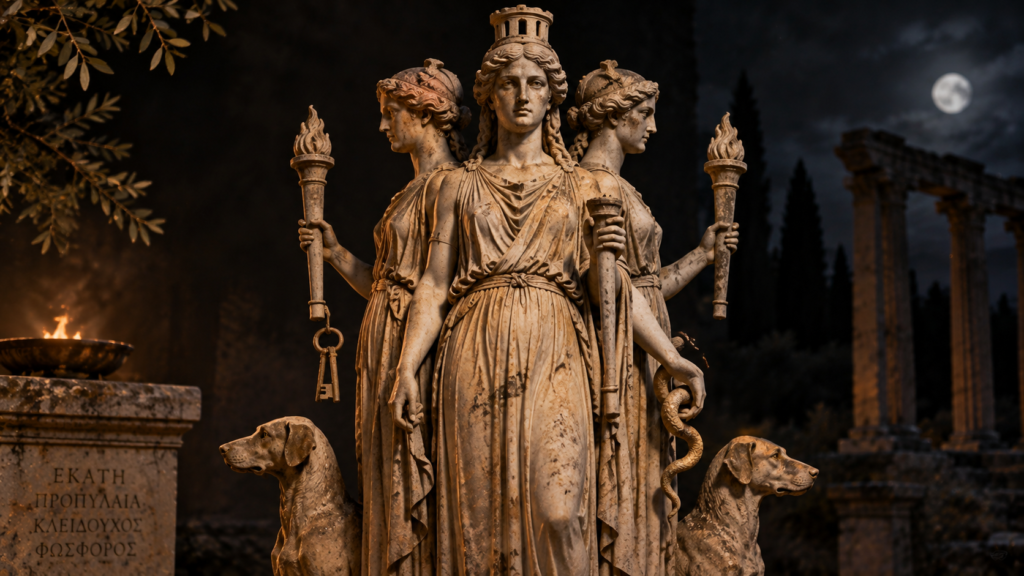
One of the most recognisable images of Hecate shows her as three women joined together, facing different directions.
This was not how she had always been represented.
Early images of Hecate generally show a single female figure. The triple-bodied form became prominent later, and the Greek sculptor Alcamenes, active in the fifth century BCE, was traditionally credited with creating an influential three-formed image of the goddess.
The symbolism fits Hecate particularly well.
At a three-way crossroads, each figure could face a different road. Her triple form therefore reinforced her role as guardian of boundaries and places of transition.
Later interpretations have attached many other meanings to the three figures, but the connection with crossroads is among the most important ancient explanations.
Was Hecate a Moon Goddess?
Hecate certainly became associated with the moon, but calling her simply “the Greek moon goddess” is misleading.
The Greeks already had lunar deities, most notably Selene, while Artemis also developed strong lunar associations.
Hecate’s connection with the moon grew over time, particularly as her associations with night, magic and Artemis became stronger.
So the moon is an important part of Hecate’s later identity, but it was not the defining feature of her earliest character.
Hecate and Dogs
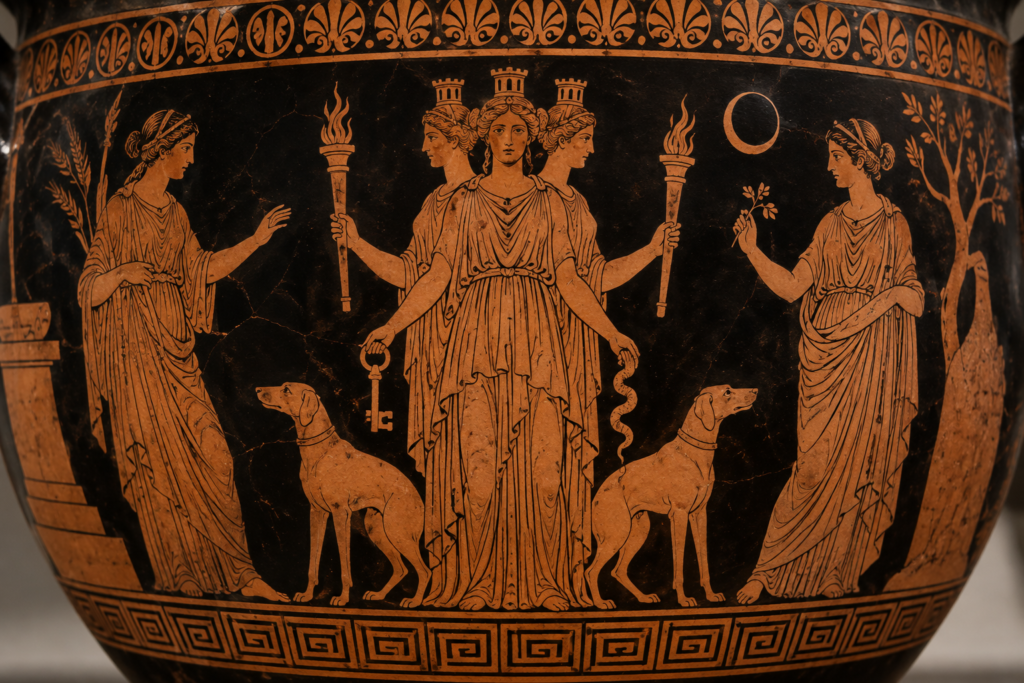
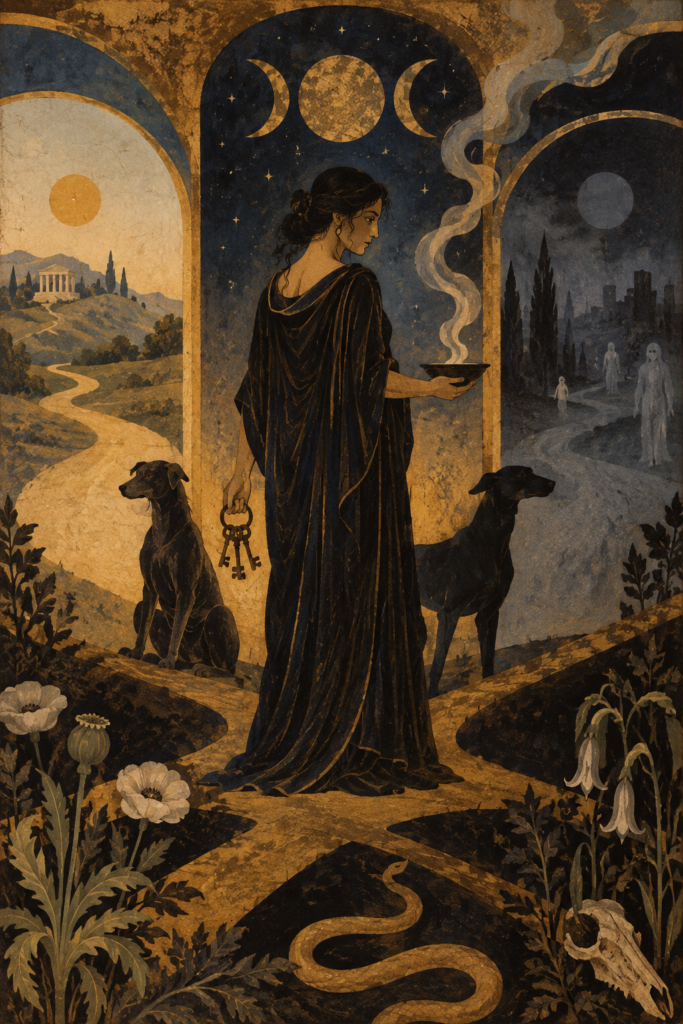
Dogs were among Hecate’s most important sacred animals.
Ancient literature frequently connects her arrival with the barking or howling of dogs, particularly at night.
Dogs also make sense symbolically. They guard entrances and boundaries — exactly the kinds of places over which Hecate held influence.
The animal therefore became one of the most persistent signs of her presence.
Hecate and Witchcraft
Hecate’s association with magic became increasingly important in Classical, Hellenistic and Roman literature.
One of the clearest connections appears through Medea, one of Greek mythology’s most famous practitioners of magic.
In Euripides’ Medea, she invokes Hecate as the goddess she honours above all others. Later writers strengthened this relationship between Hecate, magical rituals, herbs, spells and the night.
This association also connects Hecate with figures such as Medea and Circe.
By the Roman period, the image of Hecate as a mysterious nocturnal goddess of witchcraft was firmly established.
Symbols of Hecate
Several symbols became particularly closely associated with Hecate.
Torches
Hecate famously carries torches in the Homeric Hymn to Demeter.
They represent illumination in darkness and fit her role as a goddess who guides people through uncertain or dangerous spaces.
Dogs
Dogs were sacred to Hecate and were closely associated with her nocturnal appearances.
Their role as guardians also reflects Hecate’s connection with doors, entrances and boundaries.
Keys
Hecate was sometimes portrayed carrying keys.
The symbolism is appropriate for a goddess of thresholds: keys allow passage from one space into another.
Crossroads
Crossroads were among Hecate’s most important sacred spaces.
Her images could be placed where roads met, particularly at three-way junctions.
The Number Three
Hecate’s triple form made the number three particularly important in her later iconography.
Three bodies or faces allowed her to look simultaneously in several directions, making the image especially suitable for crossroads.
How Was Hecate Worshipped?
Hecate was worshipped both privately and publicly.
Offerings were left for her at crossroads, while small shrines could be placed near household entrances. A monthly ritual known as Hecate’s Deipnon involved offerings made around the dark moon.
But her worship was not confined to mysterious nighttime rituals.
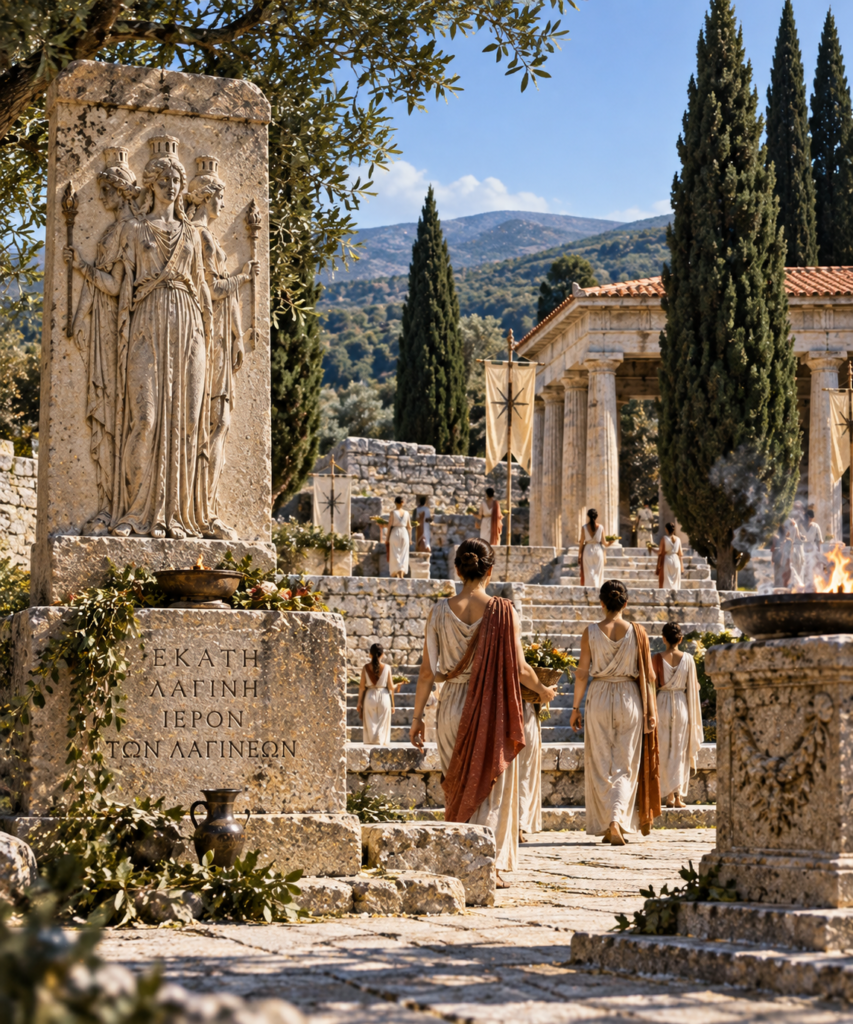
One of her most important cult centres was Lagina in Caria, in what is now southwestern Turkey.
There, Hecate possessed a monumental sanctuary and played an important role in civic and religious life. This is a useful reminder that ancient worshippers did not see her merely as a frightening goddess of witchcraft.
The sanctuary and Hecate’s civic role at Lagina are discussed in Amanda Herring’s study Hekate of Lagina: a goddess performing her civic duty.
Was Hecate Evil?
No.
Hecate could certainly be frightening. She became associated with ghosts, magic, restless spirits and the night.
But Greek gods rarely fit neatly into modern categories of good and evil.
Hecate could protect as well as frighten. She guarded entrances, helped travellers, received household worship and assisted Demeter in her search for Persephone.
Even her association with boundaries had two sides: boundaries can be dangerous, but they can also keep danger out.
Hecate in Modern Culture
Hecate has experienced a remarkable revival in modern culture.
She appears frequently in novels, television, games and modern interpretations of Greek mythology, while some contemporary Pagan and witchcraft traditions also honour her.
Modern depictions often emphasise her connections with witchcraft, the moon and feminine power.
These interpretations have helped keep Hecate unusually visible, although they sometimes obscure the much broader goddess described in ancient Greek sources.
Frequently Asked Questions About Hecate
What is Hecate the goddess of?
Hecate is associated with magic, witchcraft, crossroads, boundaries, ghosts and the night. Earlier Greek sources give her a much broader range of powers.
Who are Hecate’s parents?
Hesiod names Perses and Asteria as her parents.
Why does Hecate have three heads or bodies?
Her triple form is closely connected with three-way crossroads, allowing her to face several directions at once.
What animal is associated with Hecate?
The dog is her best-known sacred animal.
Is Hecate the goddess of the moon?
Hecate developed strong lunar associations, but Selene was the principal personification of the moon in Greek mythology.
What was Hecate called by the Romans?
The Romans generally retained the name Hecate. She was also associated with the title Trivia, particularly in connection with crossroads and her threefold form.
Hecate: A Goddess Between Worlds
Hecate is difficult to reduce to a single title.
Hesiod describes a powerful goddess honoured by Zeus across earth, sea and heaven. Later traditions increasingly place her at crossroads, beside ghosts and in the company of witches.
Yet these versions of Hecate are not entirely contradictory.
Again and again, she appears at boundaries: between roads, between darkness and light, between the household and the outside world, and eventually between the living and the dead.
For the ancient Greeks, crossroads could be uncertain places.
Fortunately, they had a goddess waiting there.
Get in Touch
What do you find most interesting about Hecate? Her role in the story of Persephone, her connection with witchcraft, or her mysterious presence at the crossroads?
Let us know in the comments below.
For anything else, contact me at richard@mythologyplanet.com