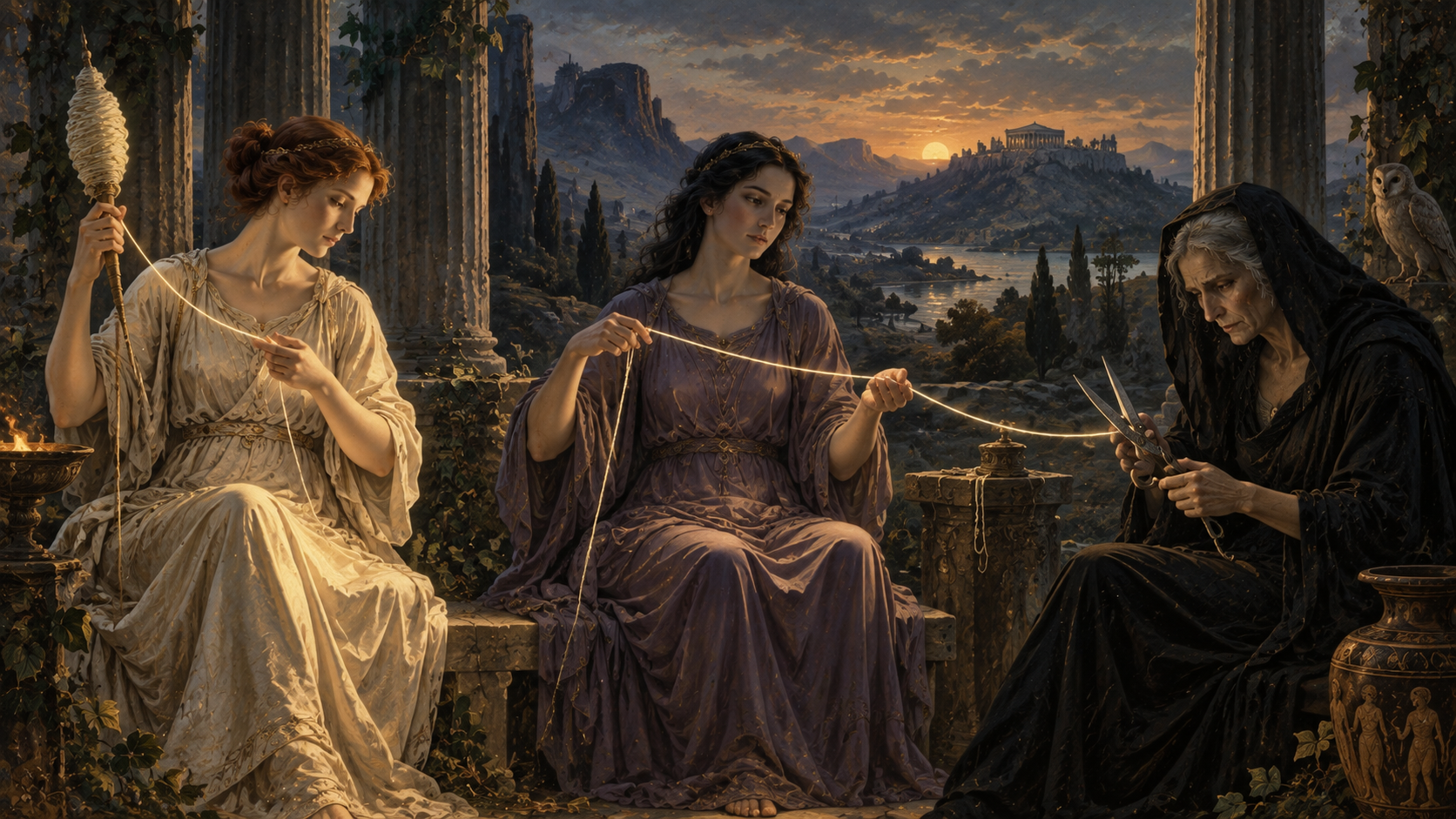
Of all the gods and monsters in Greek mythology, few have quite the same quiet menace as the Fates.
There are three of them: Clotho, Lachesis and Atropos. Together, they are the Moirai, divine figures who determine the portion of life allotted to mortals.
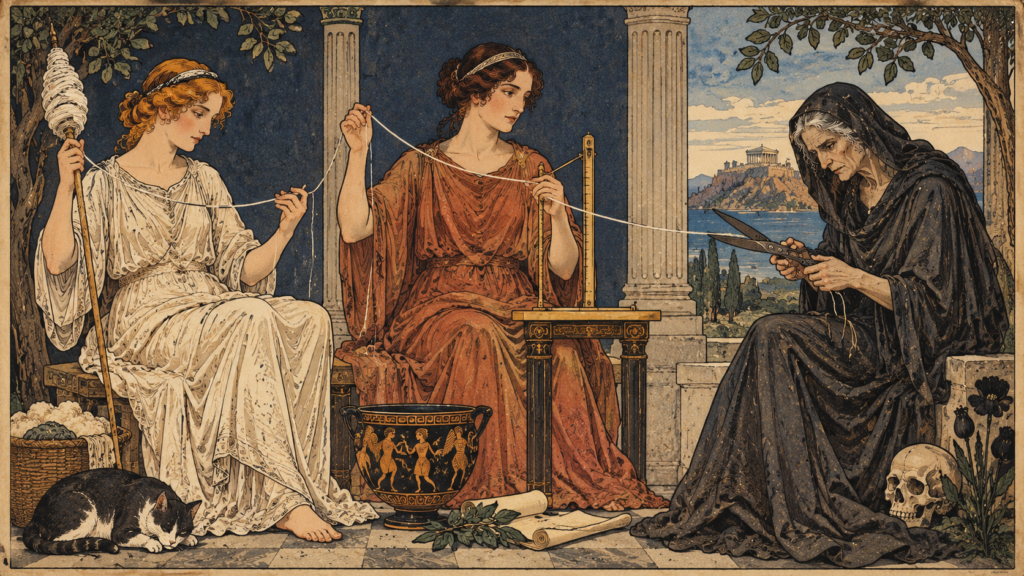
Their most famous image is wonderfully simple. Human life is a thread. One Fate spins it, another determines its portion, and the third brings it to an end.
No thunderbolts. No sea monsters. Just three women and a piece of string.
And when Atropos decides your thread has run its course, arguing about it isn’t going to get you very far.
Who Were the Three Fates?
The Greek word moira means something like a share, portion or allotted part. The Moirai therefore represent what has been allotted to an individual — including the limits of their life.
The three are:
Clotho — the Spinner
Clotho spins the thread of life. Her name is closely connected with spinning, and she became associated with the beginning and continuation of mortal life.
Lachesis — the Apportioner
Lachesis determines the portion allotted to an individual. She is the Fate who decides what share a person receives.
Atropos — the Unturnable
Atropos has perhaps the most ominous name of the three. Her name means something close to “she who cannot be turned” — the inevitable.
She brings the allotted life to its conclusion.
The familiar image is therefore easy to remember: Clotho spins, Lachesis measures and Atropos cuts.
That exact division became especially clear in later artistic representations. A sixteenth-century engraving now held by the Metropolitan Museum, for example, depicts Clotho spinning, Lachesis measuring and Atropos cutting the thread.
But Greek ideas about the Fates were older and considerably more complicated than that tidy image suggests.
Who Were the Parents of the Fates?
There isn’t one answer.
In fact, Hesiod manages to give us two.
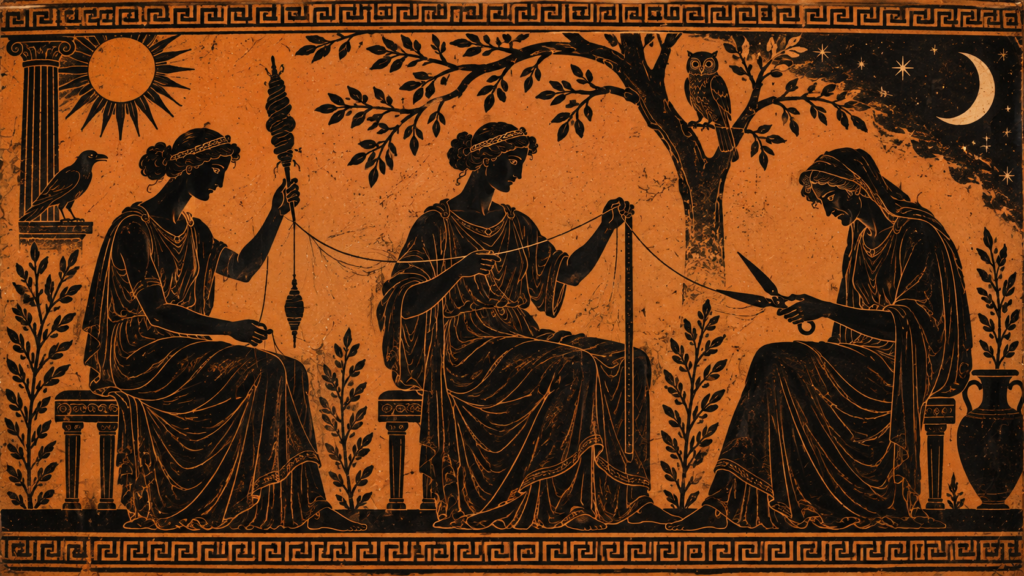
Early in the Theogony, the Fates are daughters of Nyx, goddess of Night, who produces them without a father. They appear among a distinctly unsettling collection of beings including Doom, Death, Sleep and Nemesis.
Nyx is one of the primordial beings who appear near the beginning of the Greek cosmos, something we explore further in our Greek mythology creation story.
Later in the same poem, however, Hesiod gives the Fates different parents.
This time Clotho, Lachesis and Atropos are daughters of Zeus and Themis, goddess of divine law and order. They appear alongside figures representing Order, Justice and Peace, and Hesiod says that Zeus gave the Fates great honour.
Rather than trying to “fix” the contradiction, it’s more interesting to keep both traditions.
As daughters of Night, the Fates belong to an ancient and frightening world of death, doom and forces beyond human control.
As daughters of Zeus and Themis, they fit into an ordered universe in which every being receives its proper portion.
There were other traditions too.
In Plato’s Republic, the Fates are daughters of Ananke — Necessity itself.
Which, frankly, is difficult to improve upon as a parent for Fate.
Could Even Zeus Escape the Fates?
This is one of the most interesting questions surrounding the Moirai.
Were the Fates servants of Zeus?
Or was Zeus himself subject to fate?
Greek mythology never provides a perfectly consistent answer.
Hesiod places the Moirai firmly within the divine order ruled by Zeus. He describes them as daughters of Zeus and Themis and says that Zeus granted them enormous honour.
Yet fate elsewhere feels more fundamental: a boundary that cannot simply be ignored because a god happens to dislike the result.
That tension probably tells us more than a simple answer would.
Greek writers could emphasise Zeus as the supreme ruler of the cosmos while also treating an individual’s allotted fate as something extraordinarily difficult — or impossible — to escape.
The Moirai were not simply three employees sitting in Zeus’s celestial HR department.
They represented the much bigger idea that some things, once allotted, cannot be undone.
That idea also connects them with some of the darker divine forces in Greek mythology. Our article on the chthonic deities of Greek mythology explores several other beings associated with death, divine order and the boundary between the living and the dead.
The Thread of Life
Spinning was an extremely natural metaphor for life in the ancient Greek world.
Textile production was part of everyday existence, and the process offered an obvious image for something created gradually, stretched out over time and eventually finished.
The metaphor is also wonderfully unforgiving.
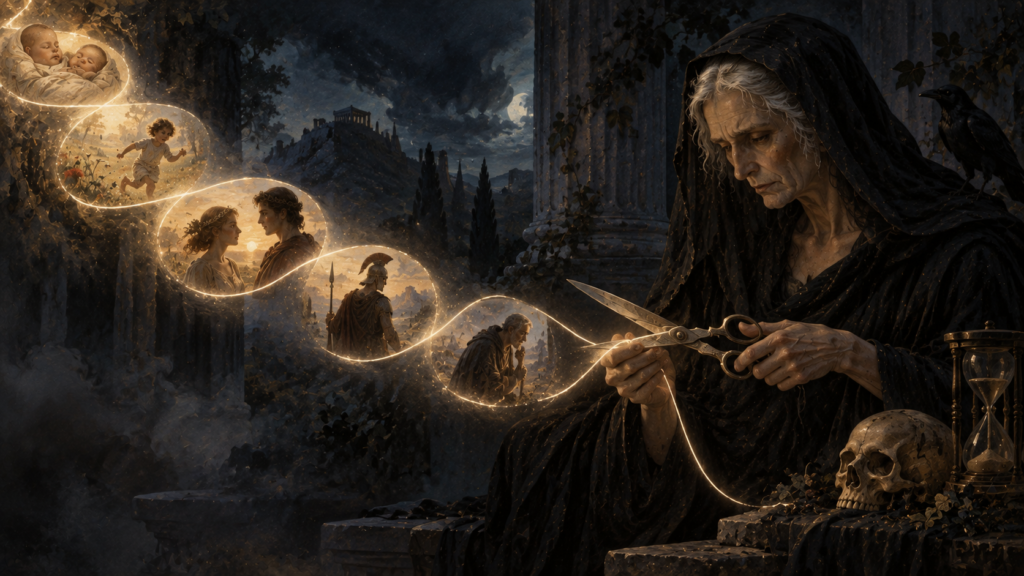
A life begins.
The thread lengthens.
And eventually it stops.
The familiar artistic image became increasingly literal. Clotho carries the spindle. Lachesis apportions or measures the thread. Atropos ends it.
The Metropolitan Museum’s engraving of the three Fates from around 1589 shows exactly this arrangement, although it obviously tells us about the long afterlife of the Greek tradition, rather than how every ancient Greek imagined the goddesses.
Ancient depictions and descriptions could be considerably less cosy.
The Fates belonged to a world of birth and allotted life, but also death and inevitability. That places them close to figures such as Thanatos, Nyx and the Erinyes, all of whom occupy similarly uncomfortable territory between divine order and human mortality.
The Fates weren’t merely keeping records.
Plato’s Extraordinary Version of the Fates
One of the strangest and most beautiful appearances of the Fates comes near the end of Plato’s Republic.
In the Myth of Er, a warrior named Er dies in battle but later returns to life and describes what he witnessed beyond death.
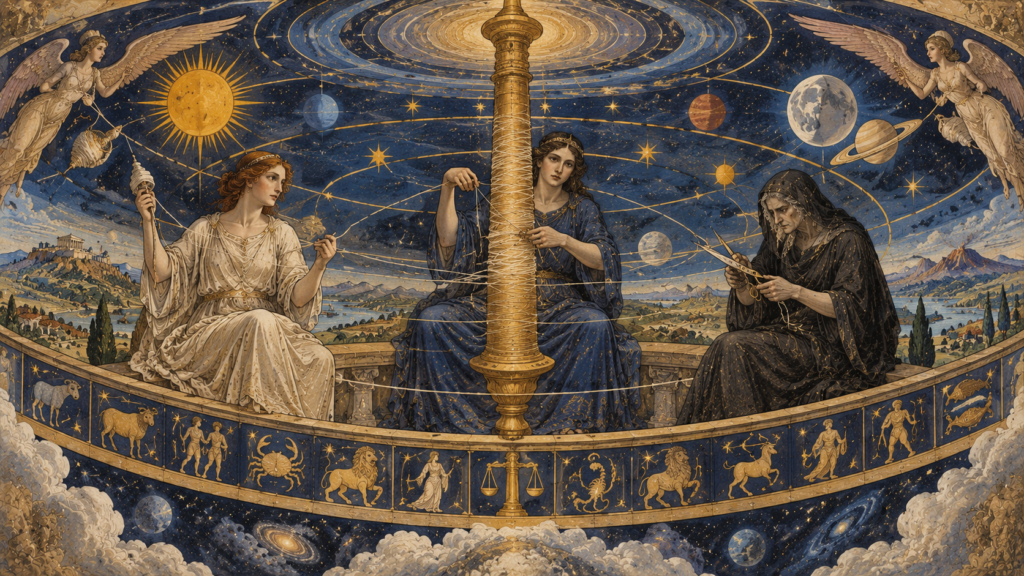
At the centre of Plato’s cosmos is an enormous spindle belonging to Ananke, Necessity.
Around it sit her three daughters — the Fates.
They are dressed in white and sing in harmony with the Sirens as the machinery of the cosmos turns around them.
But Plato gives each sister a particular relationship with time.
Lachesis sings of the past.
Clotho sings of the present.
Atropos sings of the future.
Plato then describes the souls of the dead choosing their next lives. Once those choices have been made, they pass through the cosmic order represented by the Fates and become fixed.
It’s a fascinating complication of the usual idea of fate.
The souls choose, yet their choices become part of an irreversible destiny.
Choice, necessity and fate are therefore not necessarily opposites.
And the three old women with a ball of wool suddenly become part of an enormous machine governing the universe.
Were the Fates Worshipped?
The Moirai weren’t simply literary characters or philosophical metaphors.
They also had a place within Greek religion.
Sanctuaries and images associated with the Fates existed in different parts of the Greek world, while their connection with birth, death and the allotted course of life made them relevant to some of the most fundamental concerns of human existence.
This is worth remembering because modern retellings can make the Fates feel almost like a storytelling device.
Ancient Greeks did not necessarily see them that way.
They were divine powers representing something that affected everyone.
Kings could accumulate wealth.
Heroes could win battles.
Gods could interfere.
But everybody still received a portion.
The Fates and the Romans
The Romans had their own corresponding goddesses, known as the Parcae.
Greek and Roman ideas increasingly overlapped, and the image of three divine women governing the course of human life proved remarkably durable.
Long after the ancient religions themselves had disappeared, artists continued returning to the Moirai.
The Metropolitan Museum preserves several later representations, including a 1513 woodcut by Hans Baldung and sixteenth-century engravings showing the three sisters with their familiar thread and implements.
It isn’t difficult to understand why the image survived.
A thread can be spun.
It can be stretched.
It can become tangled.
And it can be cut.
Why the Fates Still Work So Well
Greek mythology contains plenty of beings who require explanation.
The Fates aren’t really among them.
Their central idea remains immediately understandable thousands of years later: every human life has limits, and nobody knows exactly where those limits lie.
Yet the ancient Moirai are considerably more interesting than the familiar image of three old women sharing a pair of scissors.
They could be daughters of Night, daughters of Zeus and Themis, or daughters of Necessity.
They could belong to Zeus’s ordered cosmos while simultaneously representing the limits that make even divine intervention complicated.
And in Plato, they sit at the centre of the universe itself, singing of past, present and future while the cosmic spindle turns.
Clotho begins the thread.
Lachesis gives it its portion.
And Atropos makes certain that, eventually, it ends.
Of the three, she probably has the easiest job.
Get in Touch
Do you have a favourite story involving the Fates, or another figure from Greek mythology you’d like me to explore next?
I’d love to hear from you. You can contact me at richard@mythologyplanet.com.