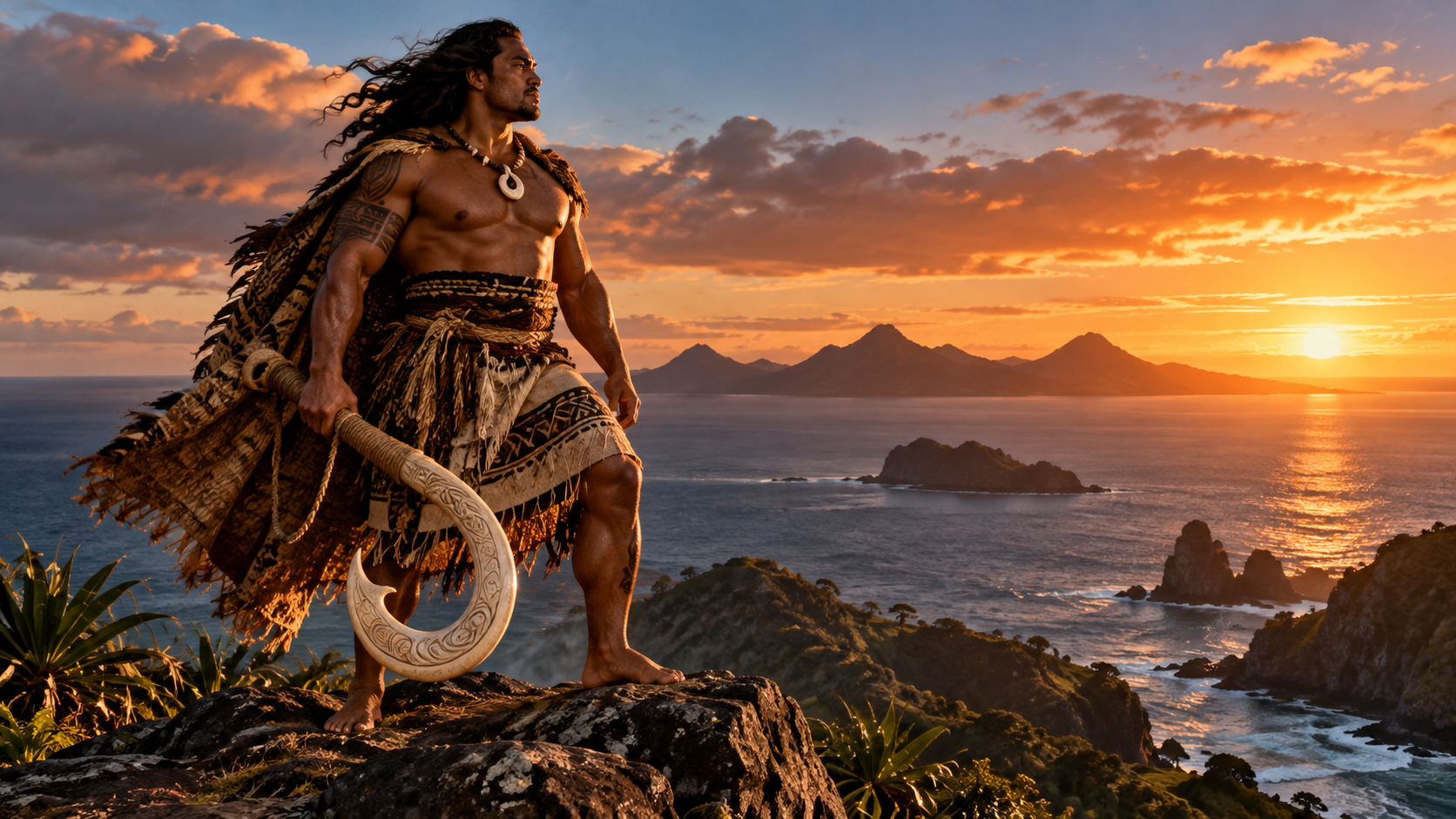
What sort of hero looks at the sun and decides it’s moving too quickly? Or goes fishing and ends up hauling an island out of the ocean?
Māui, one of the most celebrated figures in Polynesian mythology, is responsible for both feats.
A clever, daring and occasionally reckless trickster, Māui challenges powerful beings, transforms the natural world and repeatedly attempts the impossible. His adventures are told across the Pacific, from Aotearoa (New Zealand) to Hawaiʻi and beyond.
Although the details vary between traditions, Māui rarely accepts the world as he finds it. And sometimes, that gets him into terrible trouble.
Who Is Māui?
Māui is a culture hero and trickster whose adventures help explain the natural world and the human condition.
In Māori tradition, he is known as Māui-tikitiki-a-Taranga. According to one account, his mother Taranga wrapped him in a tuft of hair from her topknot and cast him into the sea. He survived and eventually returned to his family.
Related stories appear in Hawaiian, Samoan, Tongan and other Polynesian traditions, although Māui’s character and adventures differ.
His greatest weapon is usually his cleverness. He devises traps, uses magical objects and outwits beings far more powerful than himself. Yet he can also be boastful, disobedient and dangerously curious.
Modern audiences may recognise Māui from Disney’s Moana (2016), where he appears as a boastful, shape-shifting demigod. Although the film draws inspiration from Polynesian mythology, its version of Māui is a fictional adaptation rather than a faithful retelling of any single tradition.
How Māui Slowed the Sun
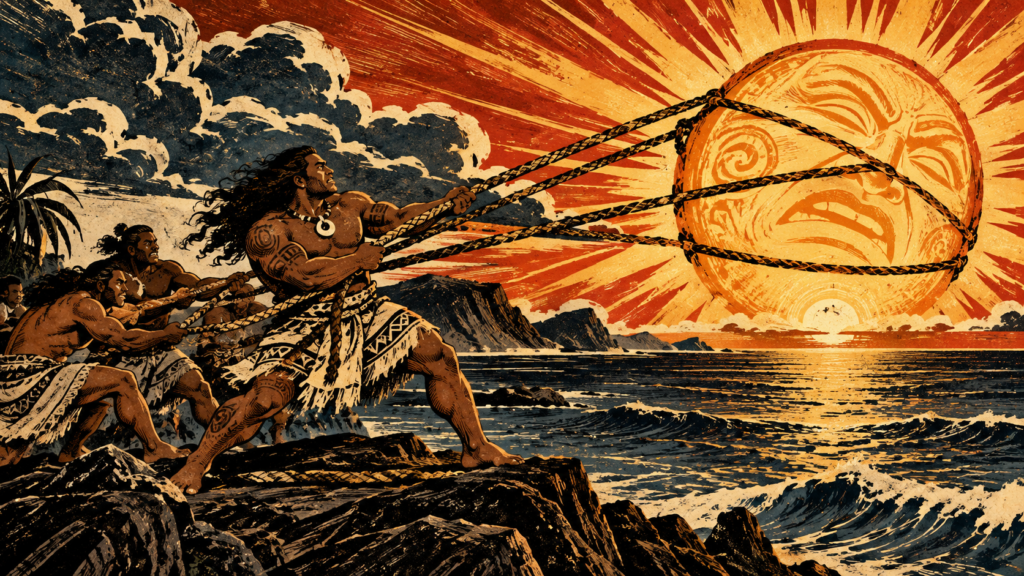
In a famous Māori story, the sun once raced across the sky so quickly that people barely had time to complete their daily work.
Māui decided to intervene.
With his brothers, he prepared strong ropes and travelled to where the sun emerged each morning. When it appeared, they caught it in their trap.
Māui struck the sun with a powerful ancestral jawbone until it agreed to travel more slowly, giving people longer hours of daylight.
A Hawaiian version offers a different explanation. Māui’s mother, Hina, struggled to dry her kapa, a cloth made from beaten tree bark, because the sun moved too quickly.
Māui snared the sun at Haleakalā and forced it to slow down.
Both traditions describe the same remarkable achievement, but their details reflect different cultural settings. The Hawaiian account is explored by the US National Park Service.
The Day Māui Fished Up an Island
Māui’s fishing expedition is among the best-known stories in Māori mythology.
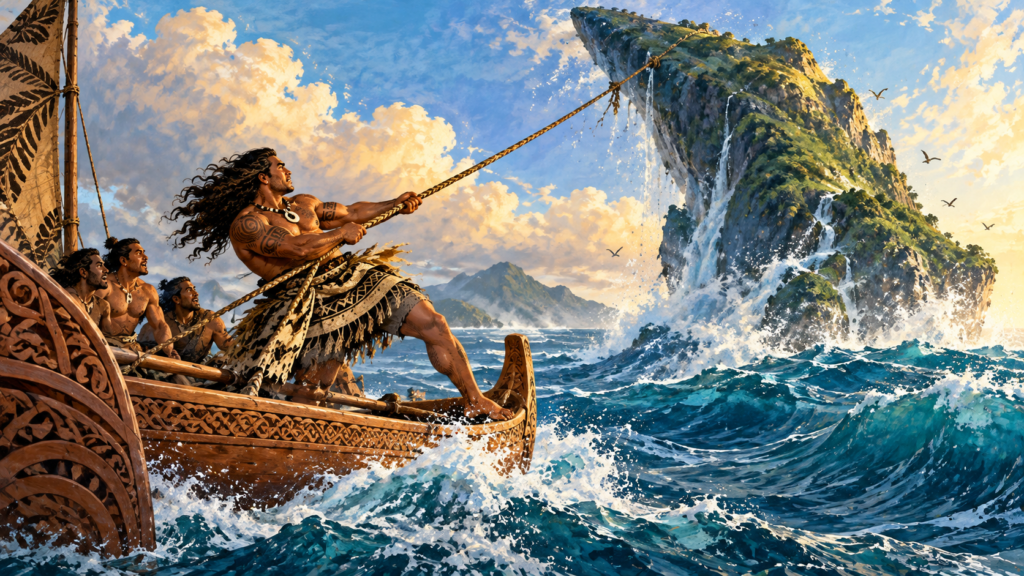
When his older brothers refused to take him fishing, he secretly hid aboard their canoe. Once they were far out at sea, he revealed himself and persuaded them to continue into deeper waters.
There, Māui lowered a magical fishhook fashioned from the jawbone of his grandmother, Murirangawhenua.
Something enormous took the bait.
With tremendous effort, Māui hauled his catch to the surface. But this was no ordinary fish. It became the North Island of Aotearoa New Zealand, known as Te Ika-a-Māui, or the fish of Māui.
The South Island is associated with his canoe, Te Waka-a-Māui.
In some versions, Māui’s brothers carved into the fish before he returned, creating the mountains and valleys of the landscape.
You can explore the tradition further through Te Ara, the Encyclopedia of New Zealand.
Māui and the Secret of Fire
Māui’s curiosity also led him to investigate the origins of fire.
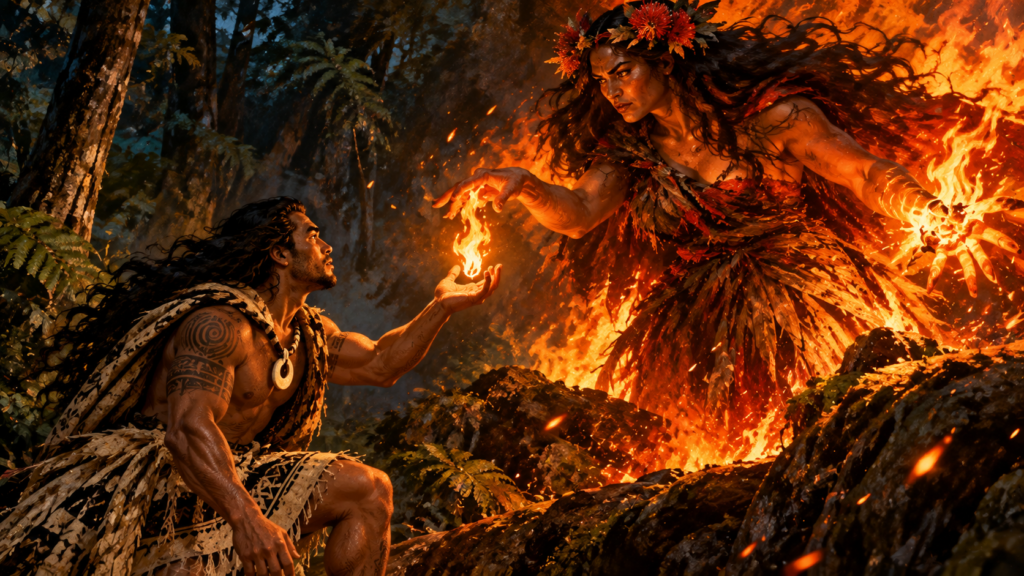
In a Māori story, he extinguished the cooking fires and visited his ancestress Mahuika, a powerful being associated with fire.
Mahuika gave him a flame from one of her fingernails, but Māui deliberately extinguished it and returned for another.
He repeated the trick until Mahuika realised what he was doing.
Furious, she unleashed her remaining fire upon him. Māui narrowly escaped, and fire was eventually preserved within certain trees, allowing people to produce flames using wood.
The adventure captures Māui’s contradictory nature: his ingenuity benefits humanity, but his recklessness destroys him.
The Trickster Who Could Not Defeat Death
For all his achievements, Māui eventually faced an opponent he could not overcome.
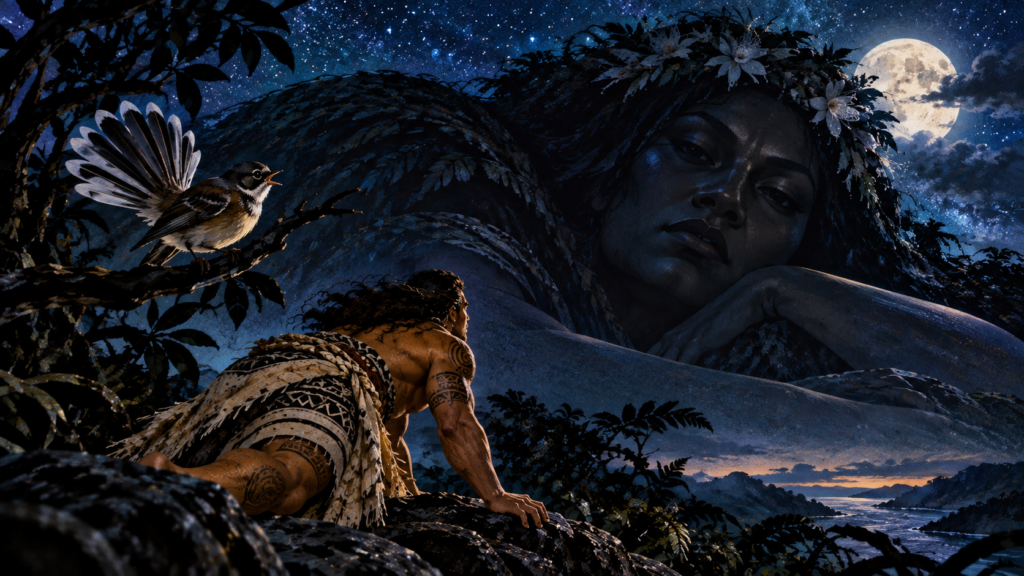
In a Māori tradition, he attempted to defeat death itself by confronting Hine-nui-te-pō, the great woman of the night.
Māui believed he could make humanity immortal by entering her body while she slept and emerging through her mouth, reversing the process of birth.
He warned the birds accompanying him not to laugh.
But as Māui began his dangerous undertaking, a fantail laughed. Hine-nui-te-pō awoke and crushed him.
The hero who had slowed the sun, raised land from the ocean and discovered the secrets of fire could not conquer death.
His failure explains why human beings remain mortal in this tradition. For further context, see Te Ara’s discussion of Māori death traditions.
Māui’s adventures connect the sun, land, fire and mortality with human experience. They also explore the uneasy relationship between intelligence and arrogance.
He is courageous and resourceful, yet mischievous and unwilling to recognise his limitations. His stories remain important within living Polynesian traditions, whose differences deserve recognition rather than being blended into a single definitive account.
There is no need to make Māui a perfect hero. His mistakes are part of what makes him memorable.
Get in Touch
Do you have a favourite Māui story, or know a version from another Polynesian tradition? I’d love to hear about it.
You can contact me at richard@blogofgames.com