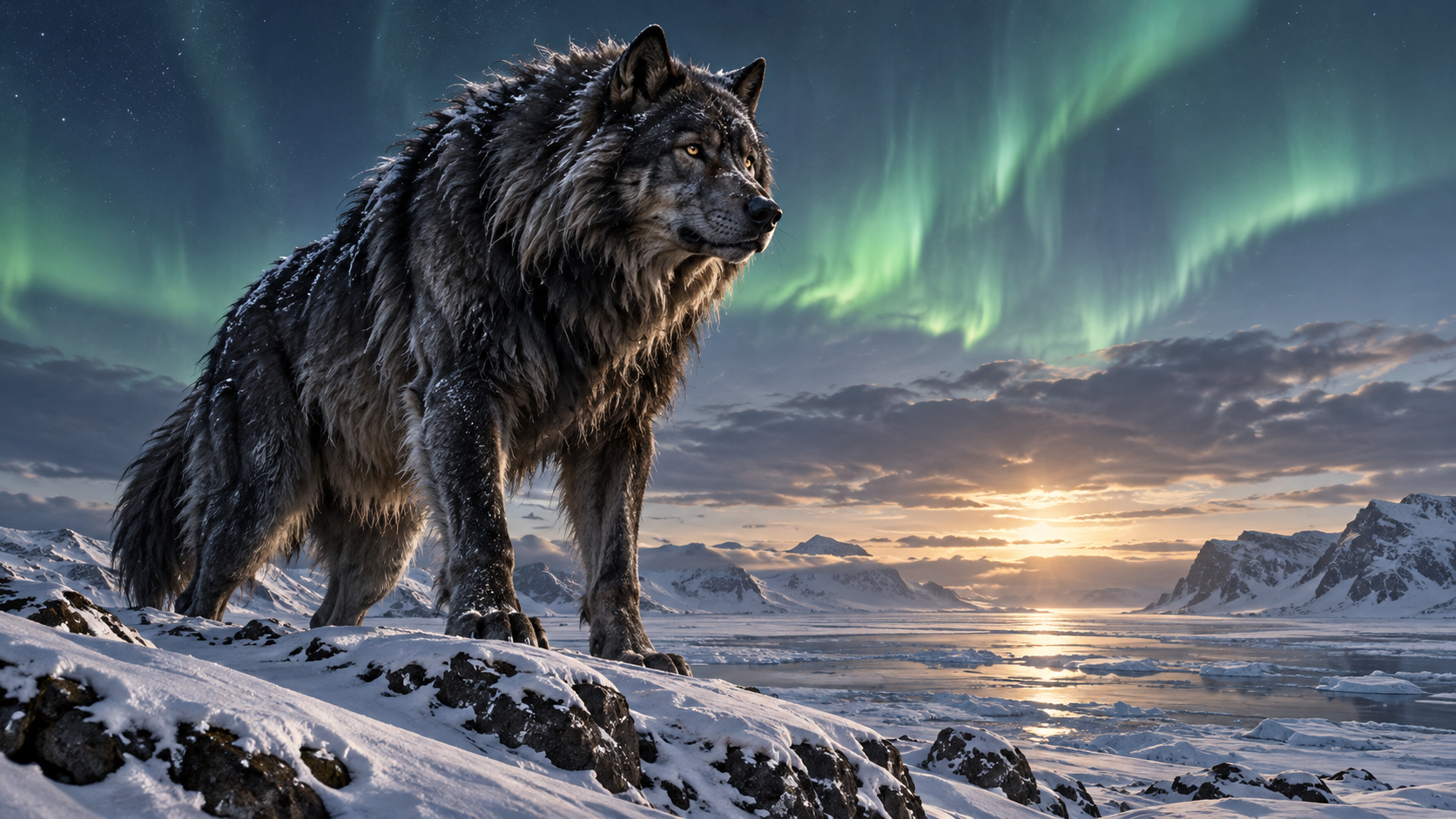
Imagine calling into the Arctic wilderness for help, only to find an enormous wolf answering your plea. Worse still, it wraps its tail around you and throws you to the ground.
This is one of the stranger encounters with Amarok, a formidable wolf-like being found in Inuit storytelling. Sometimes called Amaroq, the creature appears in tales of extraordinary strength, danger and revenge.
But Amarok is more than a monster lurking in the darkness. In one remarkable story, it becomes the unlikely source of a young boy’s strength.
What Is the Amarok?
Amarok is commonly described as an enormous, solitary wolf associated with Inuit folklore, particularly accounts recorded in Greenland. Unlike ordinary wolves, which often hunt in packs, the legendary Amarok is frequently portrayed as a creature that acts alone.
The name Amarok is closely associated with wolves, although its meaning and usage vary across Inuit languages and regions.
Some modern retellings describe Amarok as a terrifying predator that attacks people hunting alone at night. The surviving traditional accounts, however, reveal a more complicated figure.
One of our most important written sources is Tales and Traditions of the Eskimo, published in English in 1875 by Danish scholar Hinrich Rink. Although the book’s title uses historical terminology, it preserves accounts collected from Greenlandic Inuit storytellers.
Two of those stories show just how different Amarok’s roles could be.
Amarok and the Boy Kagsagsuk
Kagsagsuk was an orphan who suffered terribly at the hands of his community.
Small and physically weak, he was mocked, beaten and denied the comforts enjoyed by others. He lived with his elderly foster mother, who did what she could to protect him.
Eventually, desperate to become stronger, Kagsagsuk travelled into the mountains and called upon the Lord of Strength.
Something answered.
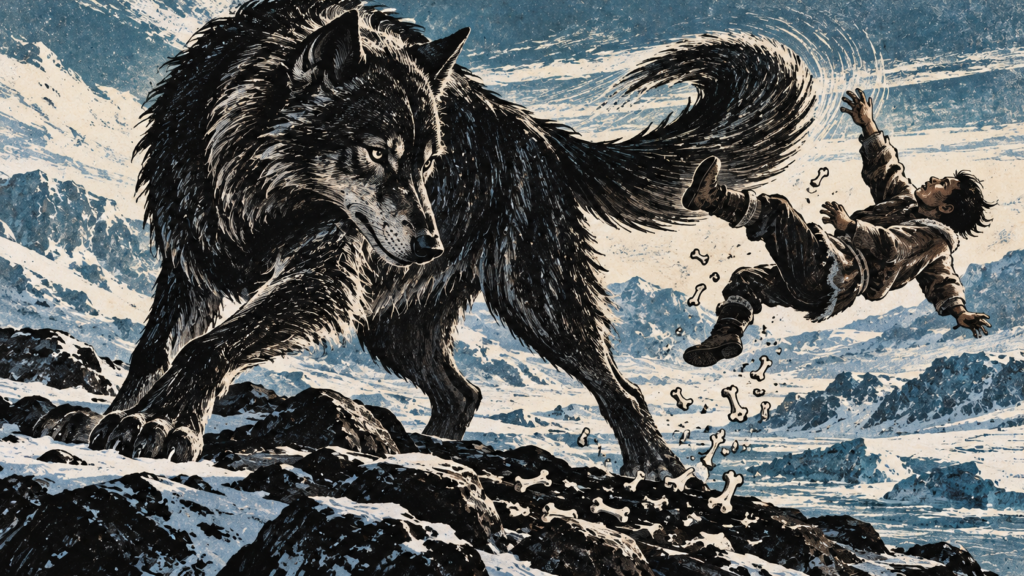
An enormous creature appeared in the form of an Amarok. The frightened boy tried to flee, but the wolf caught him, wrapped its tail around his body and hurled him to the ground.
As Kagsagsuk lay helpless, tiny bones fell from his body.
The Amarok explained that these strange bones had prevented him from growing. It threw him down repeatedly until the last of them had fallen away.
The boy returned to the mountains to meet the creature again, gradually becoming stronger through their encounters.
Eventually, his strength became extraordinary. In Rink’s account, Kagsagsuk overcame three bears, astonishing the people who had once treated him so cruelly.
The story does not end as a simple tale of forgiveness. Kagsagsuk’s newfound power also brings a troubling reversal in his relationship with the people who abused him.
Amarok, meanwhile, is not the villain. It is the mysterious being that makes his transformation possible.
The Amarok’s Revenge
Another story recorded by Rink presents a much more frightening encounter.
After hearing reports of an Amarok nearby, a man set out with a relative to find the creature. Instead, they discovered its young.
The man killed the pups.
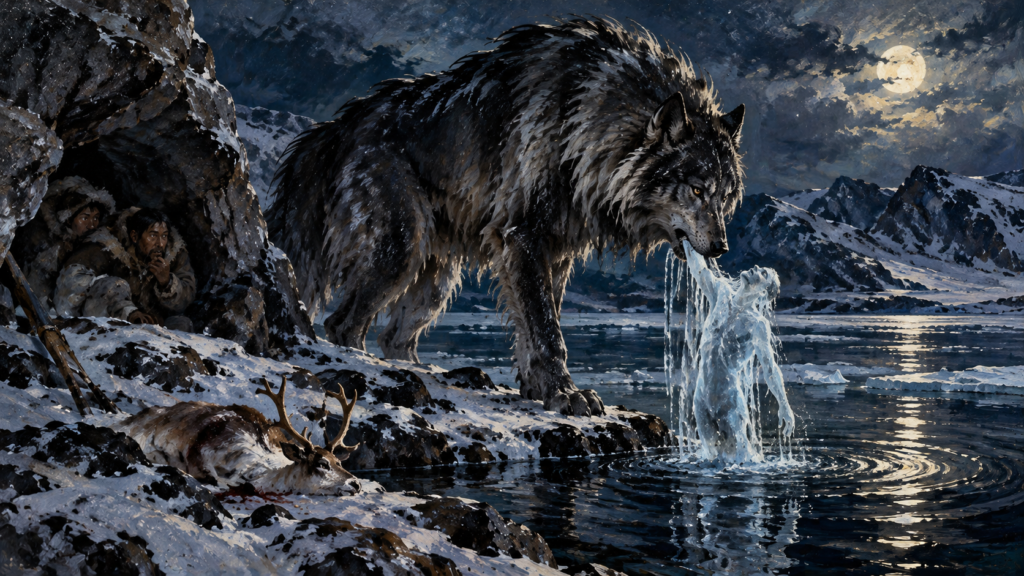
Fearing what might happen next, the two retreated to a cave. From their hiding place, they watched the adult Amarok return carrying a reindeer in its jaws.
Finding its offspring dead, the creature went to a nearby lake and drew something resembling a human body from the water.
At that moment, the man who had killed the pups collapsed.
The implication was chilling: the Amarok had taken his soul.
Here, the creature is neither a helper nor simply a hungry predator. It possesses a supernatural ability to punish someone who has harmed its young.
The two stories offer strikingly different portrayals of the same legendary being.

What Does Amarok Represent?
It’s tempting to treat Amarok as a straightforward symbol of wilderness, strength or revenge. Yet the surviving stories resist such a neat interpretation.
In Kagsagsuk’s tale, the wolf grants extraordinary strength to someone who has been mistreated. In the second account, it becomes a terrifying avenger whose powers extend beyond the physical world.
Both narratives place Amarok beyond the capabilities of an ordinary animal.
It’s also important to remember that Inuit storytelling is not one uniform tradition. Accounts differ between communities, and nineteenth-century collections represent particular storytellers and historical circumstances rather than every Inuit belief.
A scholarly study of Greenlandic animal traditions discusses these Amarok accounts and notes variations in the story of Kagsagsuk.
For readers interested in other unusual figures from Inuit folklore, there’s also Mahaha, the terrifying tickler, and the mysterious Qallupilluit, associated with the icy waters of the Arctic.
Get in Touch
Have you encountered another version of the Amarok legend, or know of a traditional account we haven’t covered? I’d love to hear about it.
Mythology Planet is always exploring the fascinating variety of stories told around the world.
You can contact me at richard@mythologyplanet.com
I BELIEVE THE AMAROK TO BE MY SPIRIT ANIMAL. I WAS IN A STRESSFUL SITUATION,TRYING TO GET A FLIGHT HOME.2 DAYS OF WAITING TO GET A FLIGHT TO UPPER MICHIGAN,THE 2ND DAY IT HAPPENED. AS I WALKING ON THE MOVING SIDE WALK AT THE AIRPORT I SAW AS CLEAR AS DAY AN IMAGE WALKING NEXT TO ME.A HUGE WOLF COLORS OF BLACK AND SILVER. HE/SHE WAS IRIDESCENT. I WAS CONFUSED,THINKING THIS WAS A REFLECTION OF ART WORK OR A SCULPTURE. AS I LOOKED AROUND THERE WAS NOTHING TO EXPLAIN THIS WONDERFUL CREATURE WALKING ALONG SIDE OF ME. AS I STARTED TO EXIT THE MOVING SIDEWALK HE/SHE LOOKED AT ME WITH ITS’ BEAUTIFUL EYES SHINNING LIGHT BLUE.THEN IT WAS GONE,DISAPPEARED TO HIS/HERS’ WORLD.THE MOMENT I SAW THIS AMAZING ANIMAL, I FELT SAFE AND THING WOULD BE O.K. ALL THE STRESS I FELT ALSO DISAPPERED.THE TIME FRAME FROM WHEN I SAW THIS WOLF TO WHEN IT LEFT WAS ABOUT 6 SECONDS. HOWEVER,THIS AWESOME EXPERINCE WILL LAST A LIFE TIME AND BEYOND.
Wow, that sounds like quite an experience! Hopefully it will bring you good fortune. All the best
Buongiorno
Qualcuno sa raccontarmi del cane Aajumaaq?
Si certo! Scriveró questo mese spero, ma in inglese probabilmente – mi dispiace! Grazie per il comment
I posit that Asena (Zena) of Turkish lore and Siena, the she wolf who suckled Romulus and Remulus, in Etruscan and Roman lore are part of the same archetype..
The Turkish historiography, albeit highly speculative, postulates that the Etruscans came to Italy from Aegean islands and their language not related to
Latln was related to a different language family.