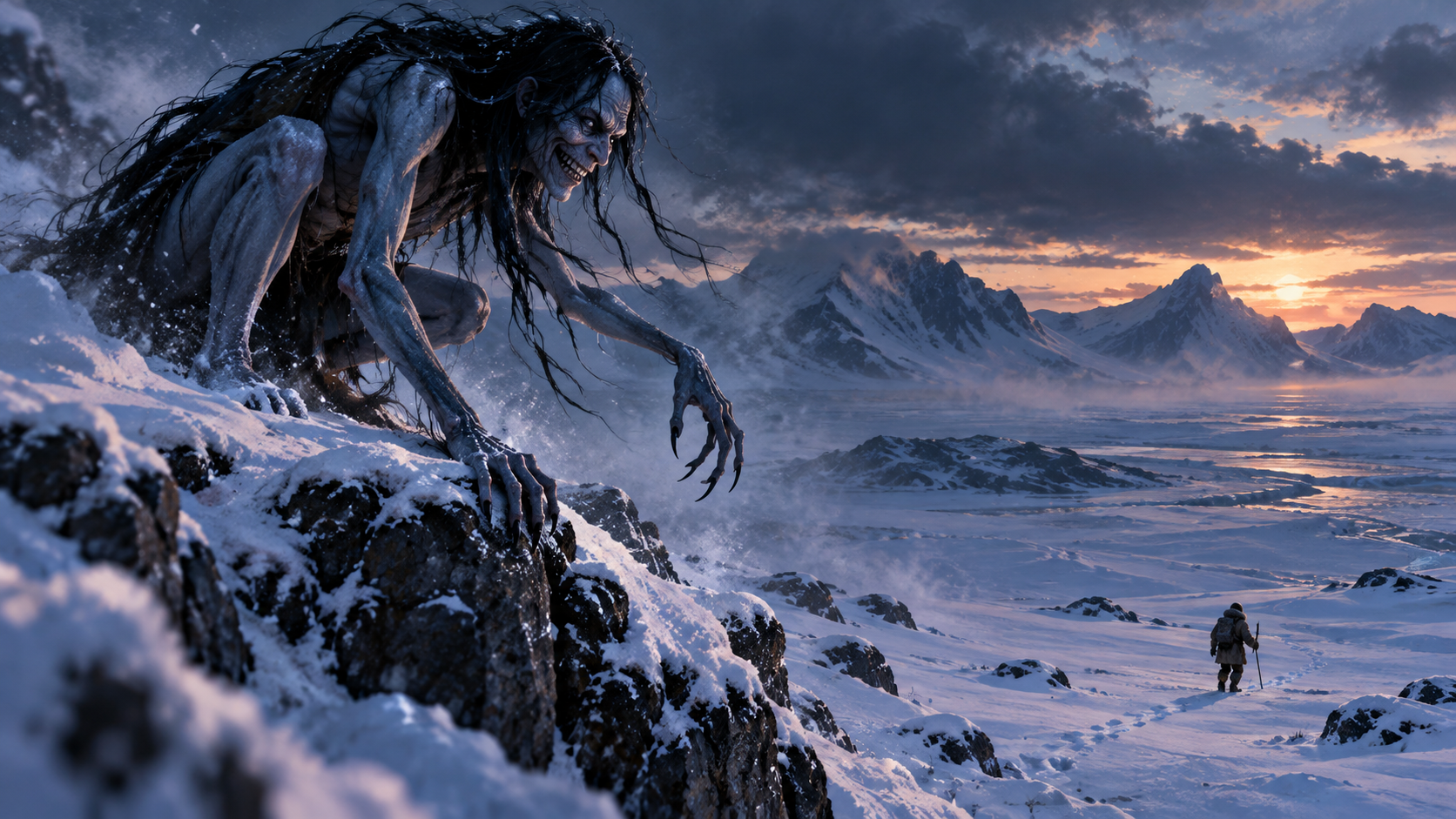
Imagine walking alone across the Arctic snow when you hear someone laughing. You turn around, but there’s nobody there. Then you hear it again, a little closer this time.
In Inuit folklore, that could mean you’ve attracted the attention of Mahaha, a sinister supernatural being with a particularly unpleasant habit: tickling people to death.
Also known as Mahaha the Tickler, this strange creature appears in stories told across parts of the Canadian Arctic. Its behaviour is bizarre, but the consequences of meeting it are anything but funny.
What Does Mahaha Look Like?
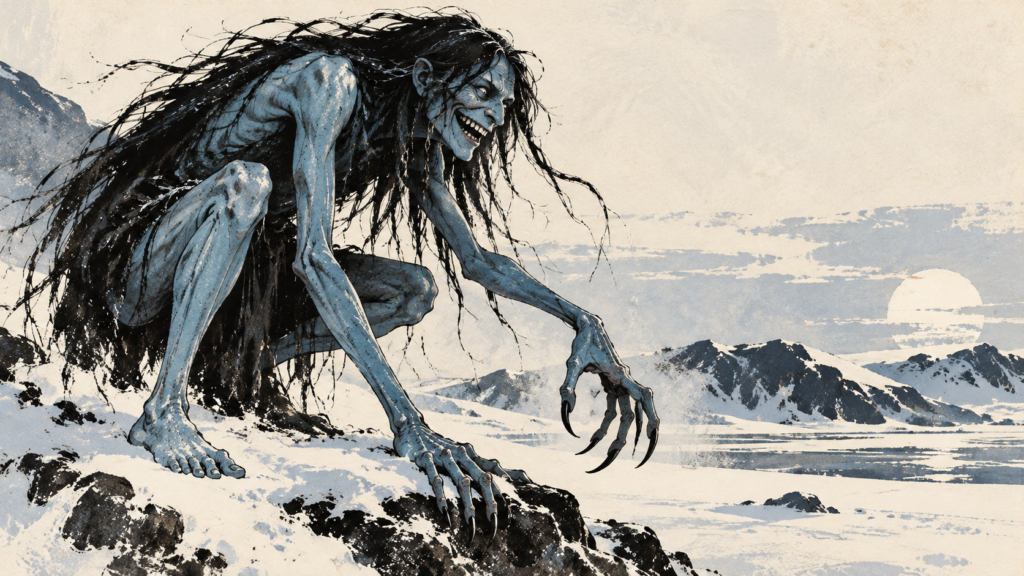
Mahaha is often described as a thin, almost skeletal figure with icy blue skin, long fingers and sharp nails. Its dark, tangled hair hangs around its face, while its pale eyes give it an unsettling appearance.
Despite the freezing Arctic conditions, Mahaha is said to wander barefoot, apparently unaffected by the cold.
Its most distinctive feature, however, is its constant laughter. Mahaha giggles and grins as it approaches its victims, seemingly delighted by the prospect of tormenting them.
According to descriptions collected by the Nunavut Bilingual Education Society, Mahaha’s victims are sometimes found with twisted, frozen smiles on their faces.
How Does Mahaha Kill Its Victims?
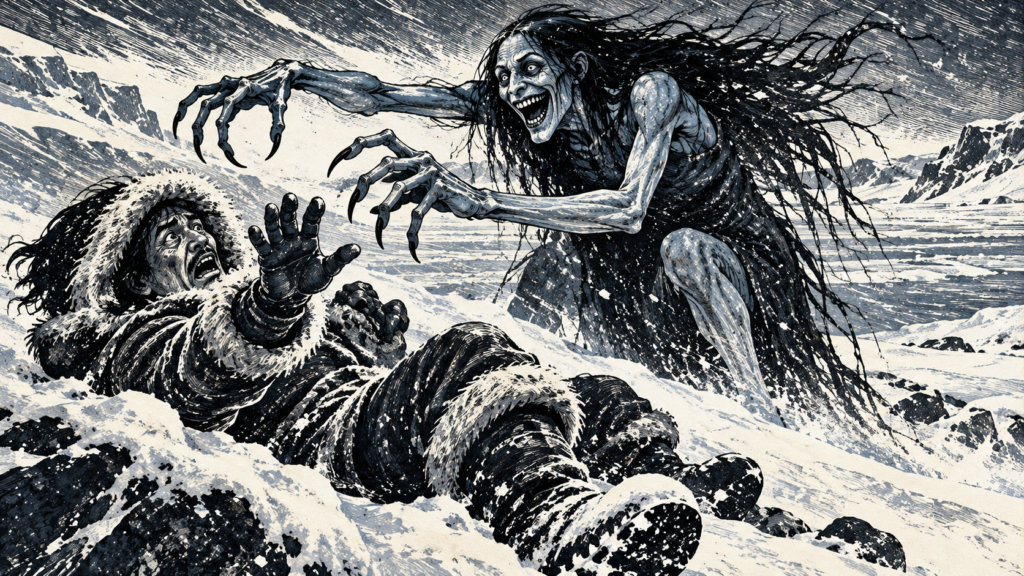
Mahaha doesn’t attack with teeth or weapons. Instead, it uses its long, clawed fingers to tickle its victims relentlessly.
The creature’s touch is described as unnaturally cold, and the unfortunate person eventually dies while laughing helplessly.
It’s an unsettling combination of comedy and horror. Something normally associated with playfulness becomes a terrifying weapon.
In an interview published by Up Here magazine, Inuit artist Babah Kalluk recalled hearing stories about Mahaha as a child. He described the creature’s laughter and the grimacing expressions left on its victims’ faces.
The details of such beings can vary between storytellers and communities, so there isn’t necessarily one definitive description of Mahaha.
How Can Mahaha Be Defeated?
For all its frightening abilities, Mahaha has one important weakness: it can be tricked.
In a story retold by Inuit writer Rachel Qitsualik in Nunatsiaq News, a man sets out to confront Mahaha after the creature kills his wife.
He attacks it, but the creature merely laughs harder. Physical strength seems useless against something that finds even a beating amusing.
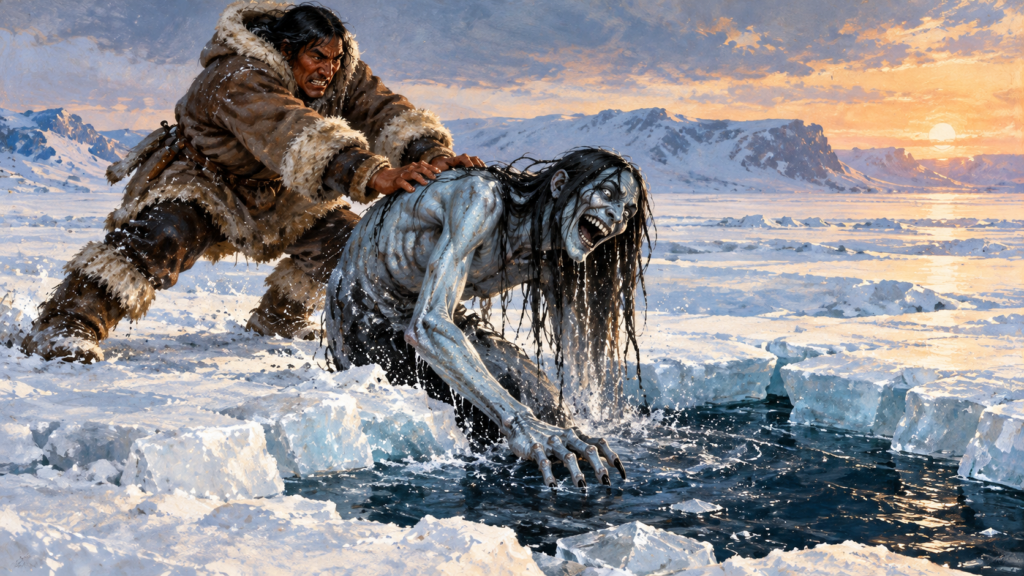
Eventually, the man flees towards a hole in the ice. When Mahaha catches up, he suggests that they share one last drink of water.
Mahaha bends down to drink, giving the man his opportunity. He pushes the creature into the freezing water and holds it there until it disappears beneath the ice.
It’s a wonderfully strange ending. The creature that can overcome people through laughter is ultimately defeated by a simple trick.
Where Do Stories About Mahaha Come From?
Mahaha belongs to the rich storytelling traditions of Inuit communities in the Arctic. Like many figures in oral traditions, its appearance and adventures can change depending on who tells the story.
These tales are not merely relics of the distant past. Inuit writers, artists and educators continue to preserve and reinterpret them.
In 2004, the Nunavut Bilingual Education Society published Taiksumani, a bilingual collection developed through research and conversations with Inuit elders. One of its stories features a young girl named Aulaja encountering Mahaha.
The project helped introduce traditional supernatural figures to younger readers through illustrated storytelling.
Mahaha’s enduring appeal is easy to understand. The creature is frightening, ridiculous and strangely memorable, sometimes all at once.
It also reminds us that folklore doesn’t always need a solemn moral. Sometimes a good story is intended to frighten, surprise or entertain its audience.
Other Creatures in Inuit Folklore
Mahaha is far from the only unsettling being associated with Inuit storytelling.
The Amarok is a formidable supernatural wolf, while the Qallupilluit are mysterious beings associated with Arctic waters and stories about children approaching dangerous ice.
There are also the Ijiraq, elusive beings connected with shapeshifting and people becoming lost.
Each has its own stories, and together they offer a fascinating glimpse into the variety of Inuit folklore.
Get in Touch
Have you come across a story about Mahaha, or another figure from Inuit folklore? I’d love to hear about it.
Leave a comment below, or contact me at richard@mythologyplanet.com.
YA thanks for the story i tell friends and they were scared half to death .It even made me lose sleep for a whole solid month