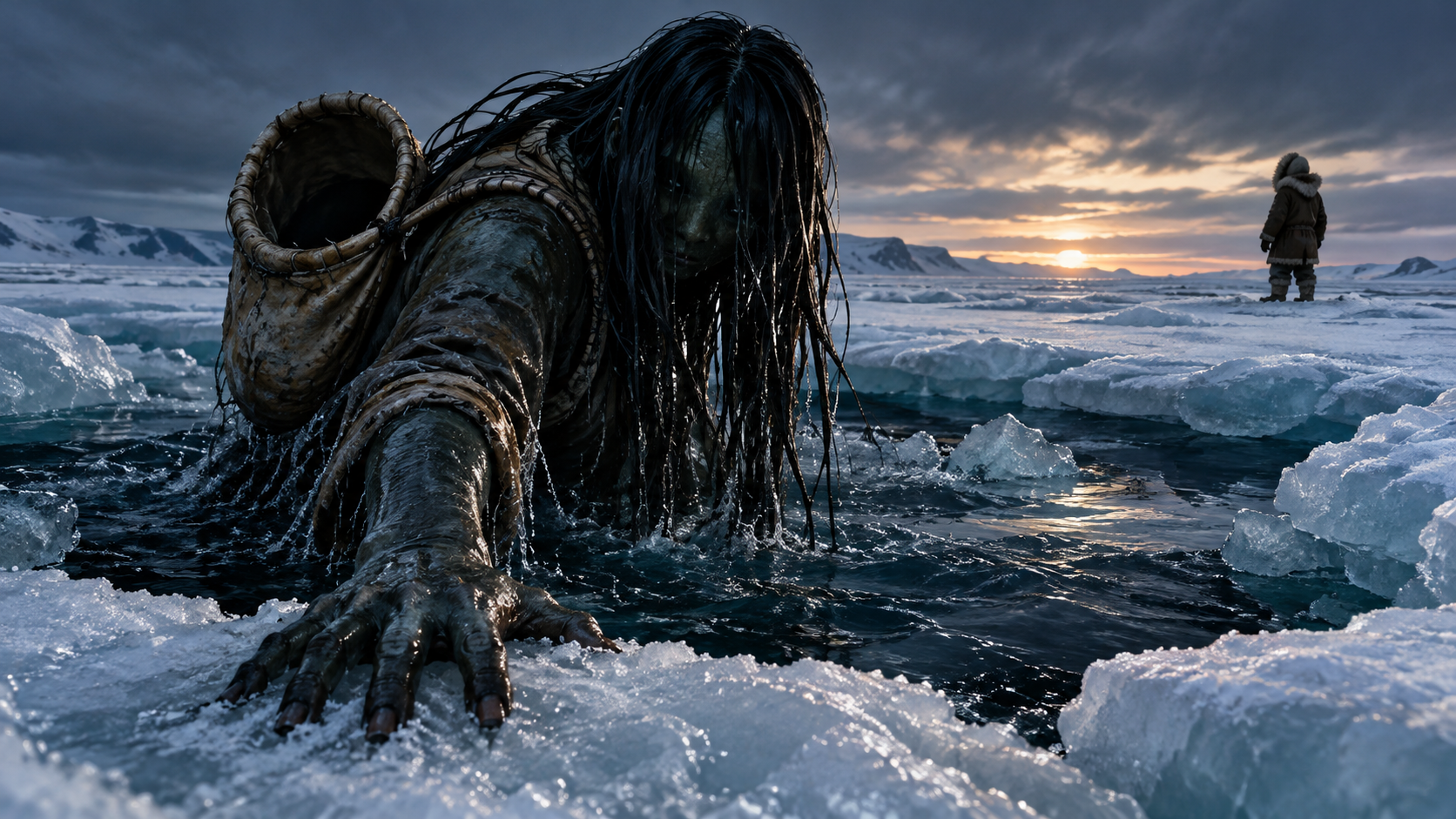
Imagine walking across the Arctic sea ice when you hear a strange humming sound beneath your feet. Somewhere below the frozen surface, something is waiting.
In Inuit folklore, that something might be a qallupilluk, a mysterious water-dwelling creature said to carry unsuspecting children away beneath the ice.
Known collectively as the qallupilluit, these frightening beings feature in stories passed down through generations. But their tales are more than simple monster stories. They also reflect the very real dangers of Arctic waters.
What Are the Qallupilluit?
The qallupilluit are supernatural beings associated with the sea, shorelines and ice in Inuit storytelling traditions.
The names vary between accounts. Qallupilluk is a singular form, while qallupilluit is plural. Other spellings and regional forms include qalupalik and qalupaliit.
Their appearance also differs between tellings. Some descriptions portray them as strange, humanlike creatures with long hair and unsettling features. Modern illustrations sometimes give them greenish skin, scales or webbed hands.
One particularly distinctive detail is the amauti, a traditional Inuit garment with a large pouch used to carry a child. In stories about the qallupilluit, the creatures use this pouch to carry children away.
The qallupilluit are sometimes compared to the bogeyman, but their connection to the Arctic sea gives them a character of their own.
The Creatures Beneath the Ice
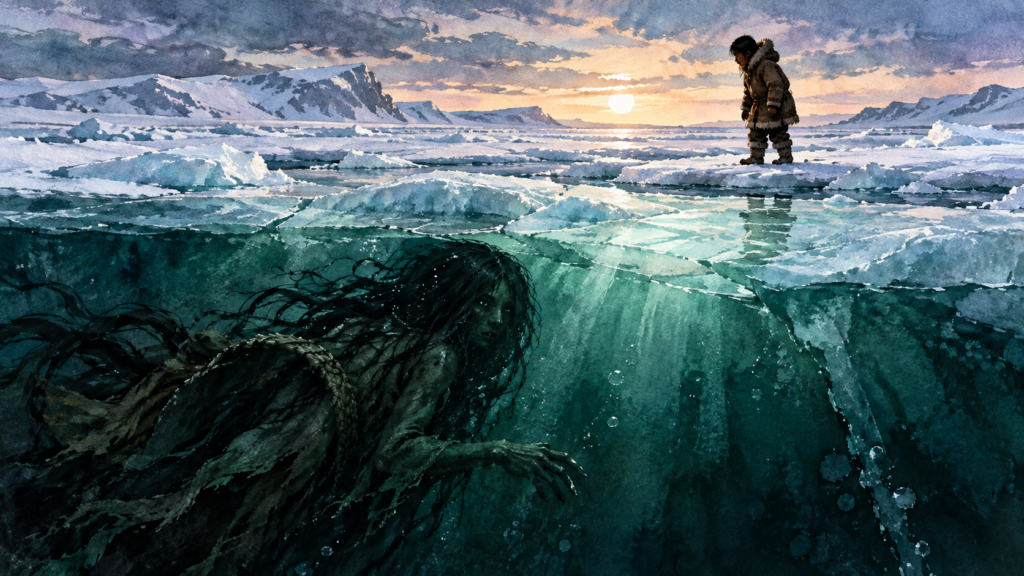
The qallupilluit are especially feared because they lurk near places where children might wander into danger.
Some accounts describe them waiting beneath the sea ice or close to the shoreline, ready to seize anyone who ventures too near.
Their strange humming is another recurring feature of popular retellings. A child drawn towards the sound might discover, too late, that something is hiding beneath the surface.
In a landscape where unstable ice and freezing water can be deadly, these stories carry an obvious warning.
For a child, the possibility of a qallupilluk waiting below the ice could be far more memorable than an ordinary instruction to stay away from the water.
Yet the creatures are not always portrayed as invincible. Some stories show that quick thinking can overcome them.
The Grandmother and the Qallupilluk
One particularly unsettling account was recorded by anthropologist Franz Boas in The Central Eskimo (1888).
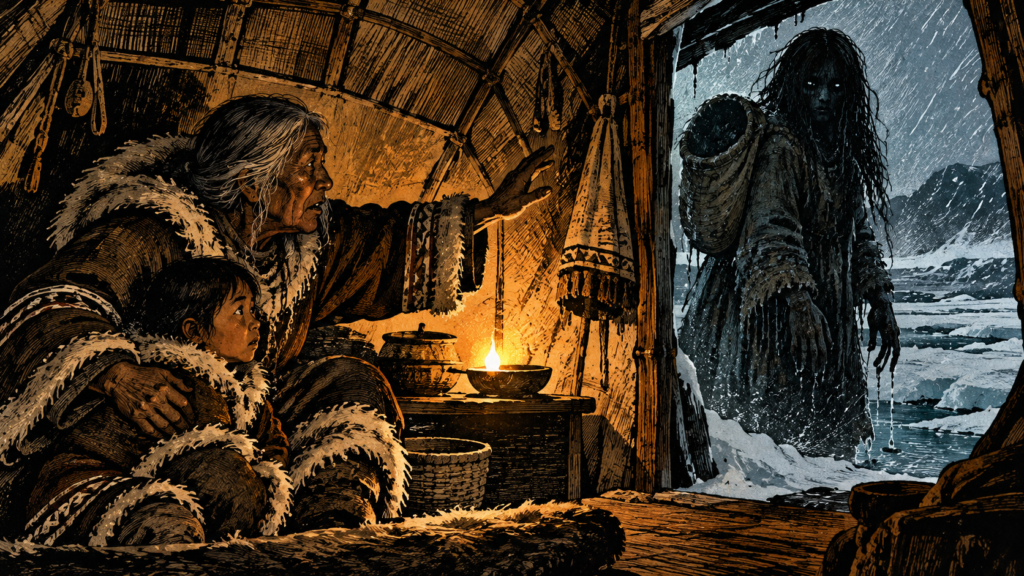
An elderly woman lived with her grandson in a small hut. They were desperately poor, relying on occasional gifts of seal meat and blubber from other Inuit families.
One day, when they had little food, the hungry boy began crying.
His grandmother ordered him to be quiet, but he continued. Losing her patience, she called upon a qallupilluk to take him away.
The creature appeared, and the grandmother placed the boy inside its enormous hood.
The qallupilluk carried him off.
The story does not end there. After hunting conditions improved, the grandmother regretted what she had done. She asked hunters to help recover the boy, who had survived in the creature’s possession.
Eventually, they managed to rescue him.
It’s a disturbing tale, not least because the danger begins with the grandmother’s own actions. But it also differs from the idea that anyone taken by a qallupilluk is necessarily lost forever.
The account can be found in Franz Boas’s The Central Eskimo.
The Qalupalik and the Clever Orphan
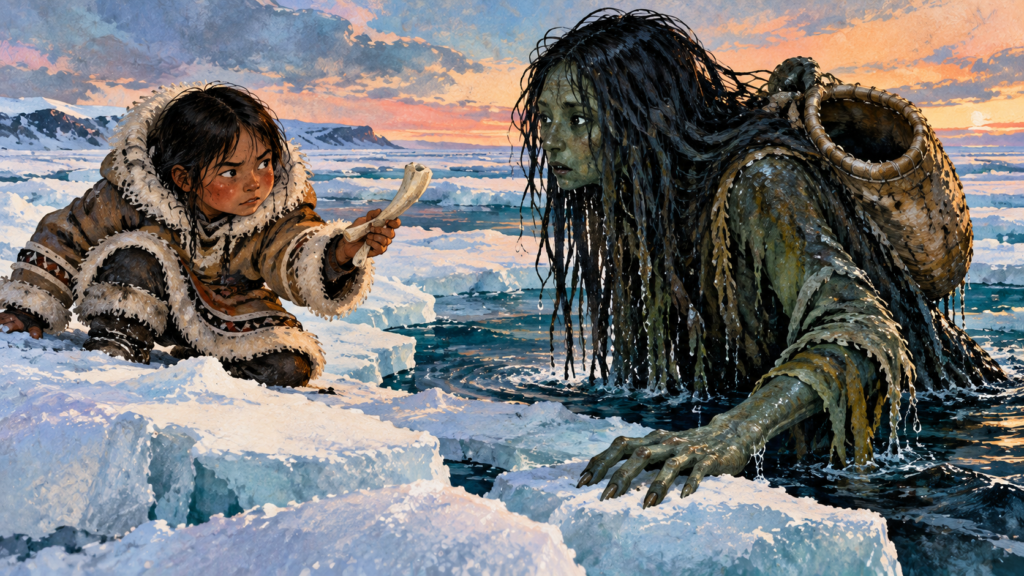
Other Inuit storytellers have preserved versions in which a child outwits the creature.
In The Qalupalik, Inuit storyteller Elisha Kilabuk recounts a traditional tale learned from his mother, Muckpaloo, who had learned it from her father.
The story follows an orphan who ventures dangerously close to the sea ice and encounters a qalupalik. Although the creature is frightening, the child proves clever enough to trick it.
This is an important reminder that the qallupilluit are not portrayed identically in every story. Some accounts emphasise the danger they represent, while others celebrate a child’s resourcefulness.
Kilabuk’s retelling was published by the Inuit-owned publisher Inhabit Media, which produces books celebrating Inuit stories, language and culture.

Why the Qallupilluit Stories Matter
The qallupilluit combine supernatural danger with an important lesson about survival.
Their stories encourage children to respect the sea, avoid unsafe ice and listen to the warnings of their elders. At the same time, tales of clever escapes show that courage and ingenuity can matter as much as obedience.
They also belong to living Inuit storytelling traditions, with differences between communities and individual storytellers.
For another chilling Arctic creature, discover Mahaha, the tickling spirit of Inuit folklore, or explore the legend of Amarok, the giant wolf.
Get in Touch
Have you heard of the qallupilluit before? Do you know another version of their stories? I’d love to hear about it.
Leave a comment below, or contact me at richard@mythologyplanet.com