
Before Zeus ruled from Mount Olympus, Greek mythology imagined a much older world.
The best-known account survives in Hesiod’s Theogony, composed around the late eighth or seventh century BCE. There is no single creator deliberately making the universe. Instead, the cosmos gradually takes shape as primordial beings emerge and successive generations of gods are born.
What begins with Chaos eventually becomes a struggle between Titans and Olympians, ending with Zeus at the head of a new divine order.
In the Beginning Was Chaos
Hesiod begins simply: first came Chaos.
This doesn’t necessarily mean chaos in the modern sense of complete disorder. The Greek khaos is often understood as something closer to a gap or yawning emptiness. Hesiod doesn’t describe Chaos creating or ruling the universe. It simply exists at the beginning.
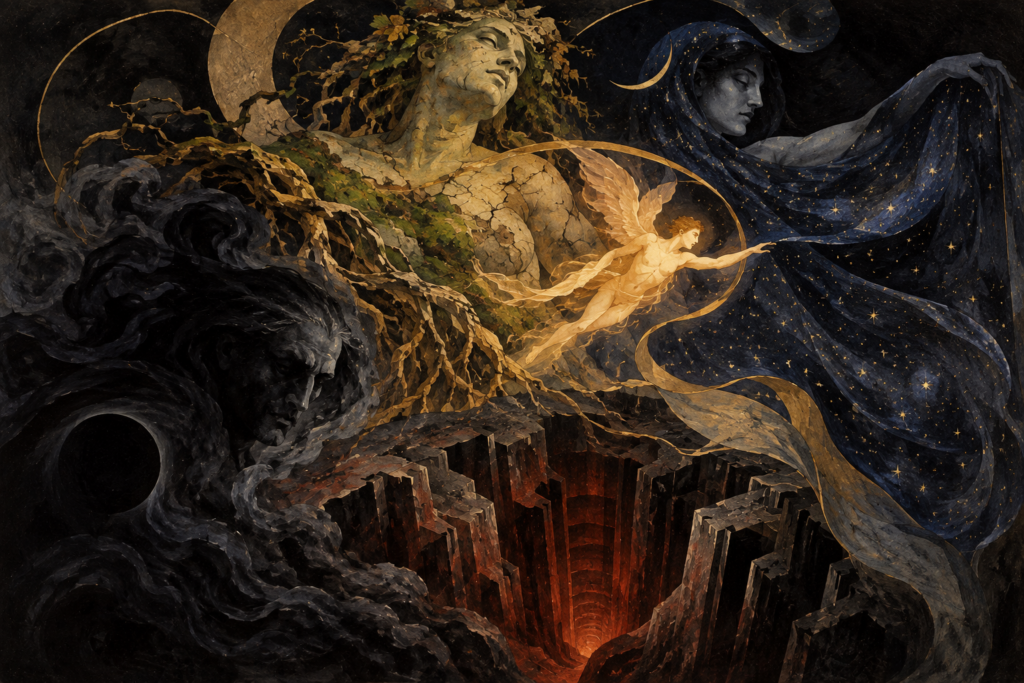
Then come Gaia, the Earth; Tartarus, the deep region beneath the Earth; and Eros, the force of desire. From Chaos emerge Erebus, associated with darkness, and Nyx, or Night.
You can read this opening sequence in Hesiod’s Theogony at the Perseus Digital Library.
These earliest beings are often described as primordial deities. Rather than behaving like the later Olympians, many represent fundamental parts or forces of existence. Our article on Erebus in Greek mythology explores one of them in more detail.
Gaia produces Uranus, the starry Sky, along with the mountains and Pontus, the Sea. Gaia and Uranus then become parents to the twelve Titans, three one-eyed Cyclopes and three Hundred-Handers, or Hecatoncheires.
The Greek cosmos is beginning to take shape, but its first divine family is already heading towards conflict.
Uranus, Cronus and the First Overthrow
Uranus hates some of his children and hides them away within Gaia, causing the Earth great suffering.
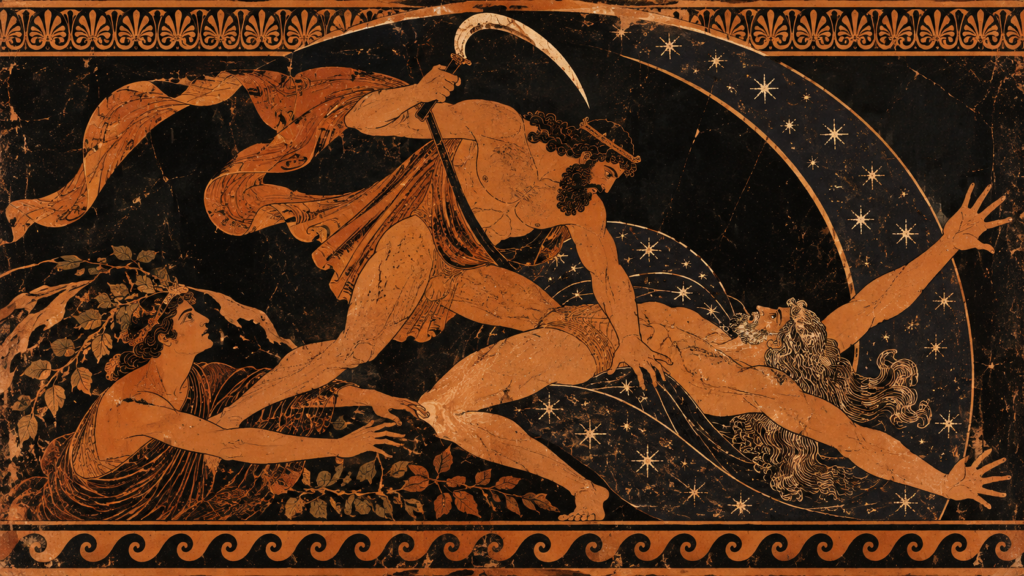
Gaia fashions a sickle and asks her children to help overthrow their father. Only the youngest Titan, Cronus, is willing.
When Uranus descends upon Gaia, Cronus attacks and castrates him. Drops of Uranus’ blood fall upon the Earth, from which emerge the Giants, Meliae and Erinyes, better known as the Furies of Greek mythology.
Cronus throws Uranus’ severed genitals into the sea. In Hesiod’s famous account, foam gathers around them and Aphrodite emerges, eventually coming ashore on Cyprus.
Cronus has overthrown his father and taken his place. But Uranus and Gaia warn that he too is destined to be defeated by one of his children.
Cronus and the Birth of Zeus
Cronus and his sister Rhea have six children: Hestia, Demeter, Hera, Hades, Poseidon and Zeus.
Fearing the prophecy, Cronus swallows the first five as soon as they are born.
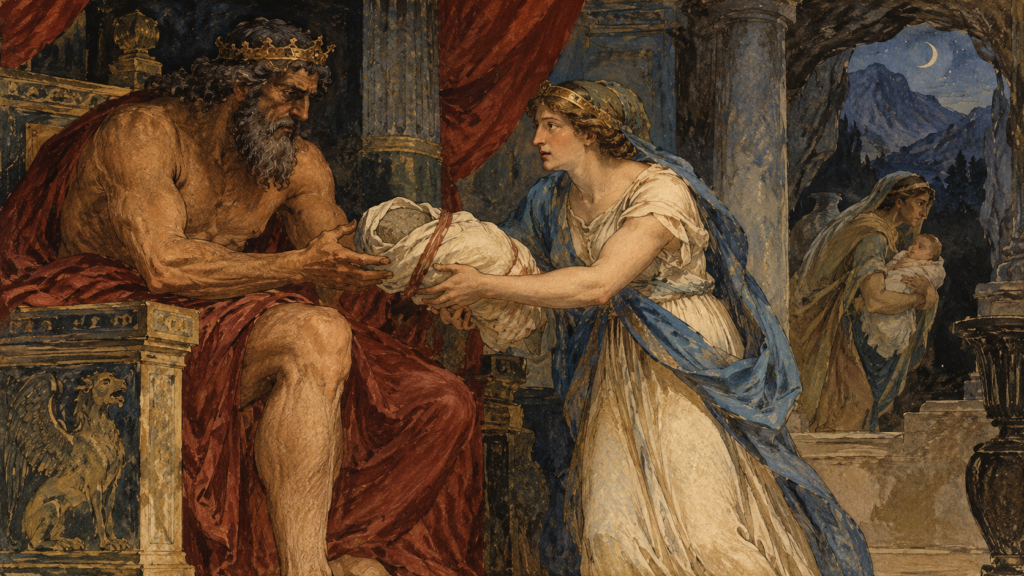
When Rhea becomes pregnant with Zeus, she seeks help from Gaia and Uranus. Zeus is secretly born on Crete, while Rhea gives Cronus a stone wrapped in swaddling clothes. He swallows it without noticing the deception.
Later traditions developed numerous stories about Zeus’s childhood, but Hesiod gives relatively little detail. Once Zeus reaches maturity, Cronus is made to bring back up the five children he swallowed, who emerge alive.
The conflict between father and son is explored further in our article on Zeus and Cronus.
Zeus also releases the Cyclopes and Hundred-Handers. The younger generation now has some formidable allies.
The Titanomachy and Rise of Zeus
The resulting war between Zeus and the older Titans became known as the Titanomachy.
According to Hesiod, it lasts for ten years. The younger gods fight from Mount Olympus and the Titans from Mount Othrys, with neither side initially able to secure victory.
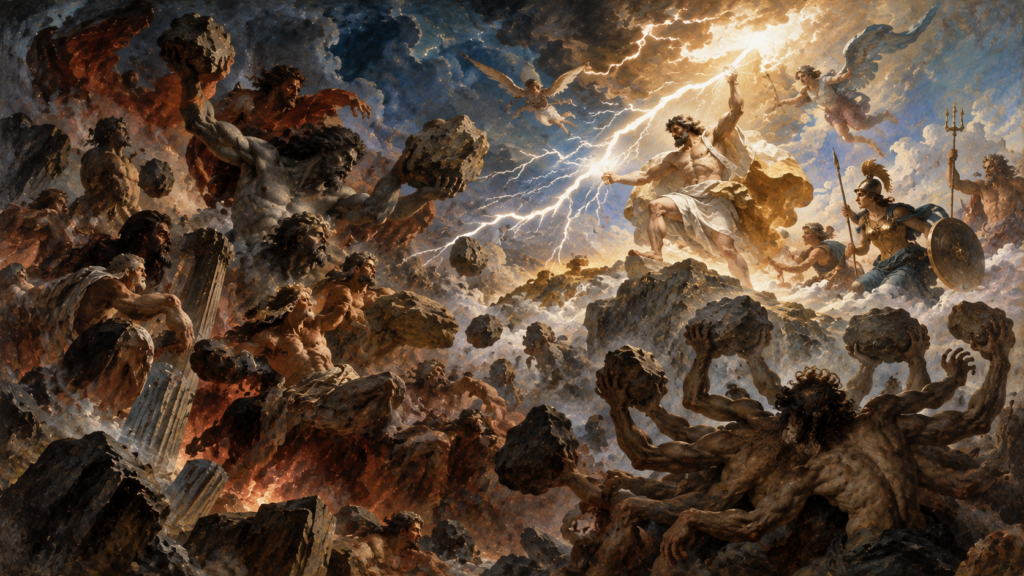
The Cyclopes give Zeus the thunder and lightning that become his characteristic weapons. The Hundred-Handers provide even more dramatic assistance, hurling hundreds of rocks at the Titans as Zeus unleashes his thunderbolts.
The Titans are finally defeated. Those who opposed Zeus are imprisoned in Tartarus, guarded by the Hundred-Handers.
Cronus’ attempt to prevent the prophecy has failed. Just as he overthrew Uranus, his own son has now overthrown him.
Zeus and his siblings become the dominant generation of gods. Zeus takes the sky, Poseidon the sea and Hades the realm of the dead, while the wider Olympian family gradually develops. You can meet the major members of this generation in our guide to the Twelve Olympian gods.
Zeus still faces challenges. Hesiod describes Typhoeus, better known as Typhon, a monstrous child of Gaia and Tartarus who threatens his new rule. Zeus defeats him with his thunderbolts, a battle covered in our article on Typhon vs Zeus.
The age of the Titans is over. The age of Zeus has begun.
Why the Greek Creation Story Matters
One interesting feature of Hesiod’s story is how early the actual creation happens. Earth, Sky, Sea, Night and other parts of the cosmos emerge near the beginning. Much of what follows is really about who gets to rule that world.
Uranus suppresses his children and is overthrown by Cronus. Cronus then tries to prevent his own children replacing him, only to suffer the same fate at the hands of Zeus.
This succession connects the strange primordial world of Chaos and Gaia with the familiar mythology of Olympus. The Olympians didn’t simply appear as rulers of the universe. They are the latest generation of a much older divine family.
From here comes the world in which the great heroes of Greek mythology, monsters and most familiar Greek myths eventually appear.

Was This the Only Greek Creation Story?
No. Hesiod’s Theogony provides the most influential surviving account, but ancient Greek religion had no single sacred text establishing an authorised creation story.
Orphic traditions, for example, developed different cosmogonies involving figures such as Chronos, a cosmic egg and the primordial deity Phanes.
Even familiar gods could have different origins. Hesiod describes Aphrodite emerging after the castration of Uranus, while Homer’s Iliad calls her the daughter of Zeus and Dione.
These contradictions are part of Greek mythology rather than errors that need fixing. Stories developed across different places, periods and traditions.
Hesiod gives us one enormously influential path: from Chaos and the primordial world, through Uranus and Cronus, to Zeus and the Olympians.
Everything else comes afterwards.
Get in Touch
Which part of the Greek creation story would you like to explore in more detail? If there’s a god, Titan or primordial deity you’d like to see covered next, I’d love to hear from you.
You can contact me at richard@mythologyplanet.com.