
The Riddle of the Sphinx is one of the most famous puzzles in Greek mythology.
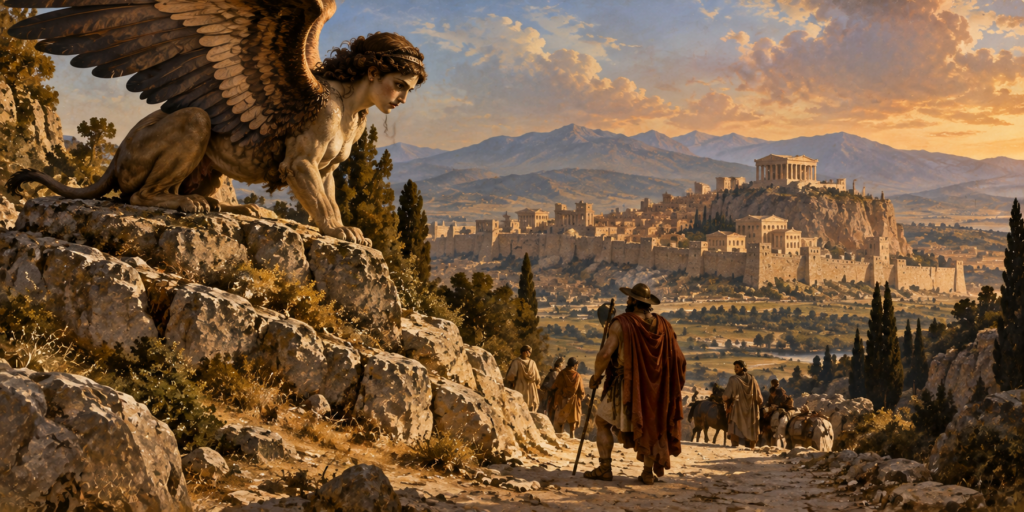
A monstrous Sphinx had settled near the city of Thebes, where she challenged people to answer a riddle. Those who failed were killed, and nobody seemed capable of giving her the answer.
Then Oedipus arrived.
He correctly realised that the answer to the Sphinx’s riddle was a human being. In doing so, he freed Thebes, became its king and married its widowed queen, Jocasta.
It sounds like a remarkably successful day. Unfortunately, Jocasta was his mother.
Oedipus would become one of the most tragic figures in Greek mythology, and you can find him alongside many others in our guide to the heroes of Greek mythology.
What Was the Sphinx?
The Sphinx of Greek mythology was usually depicted as a winged creature with the body of a lion and the head of a woman.
This makes her quite different from the Great Sphinx of Giza and other Egyptian sphinxes, which were generally male and lacked wings. The two traditions share a modern name, but they developed in very different cultural settings.
Ancient Greek art gives us a good idea of how the creature was imagined. A spectacular marble Sphinx at the Metropolitan Museum of Art, dating to around 530 BC, shows the familiar winged female form. It originally stood on top of a grave monument and even retains traces of its ancient paint.
The Sphinx also belonged to a rather unpleasant family.
In Hesiod’s Theogony, she is the offspring of Echidna and Orthus, connecting her with a monstrous family that also includes Cerberus, the Hydra and the Nemean Lion. Other traditions give her different parents, including Typhon and Echidna.
Her connection with Thebes is similarly ancient. Hesiod describes her as bringing destruction to the Cadmeans, the people associated with Cadmus, the legendary founder of Thebes.
Importantly, this was Thebes in Boeotia, central Greece, rather than the ancient Egyptian city of the same name.

Why Did the Sphinx Terrorise Thebes?
As is often the case in Greek mythology, there are different versions of the story.
One of our fullest accounts comes from the Bibliotheca, traditionally attributed to Apollodorus. Here, Hera sends the Sphinx to Thebes, where she settles on Mount Phicium and challenges the Thebans with a riddle she had learned from the Muses.
Anyone who failed to answer correctly was killed and devoured.
The Thebans knew from an oracle that they would only be free of the Sphinx once somebody solved her riddle, so they repeatedly gathered to consider the answer. Unfortunately, the Sphinx continued killing them.
Eventually, Creon offered the kingdom of Thebes and the hand of Jocasta, widow of the former king Laius, to whoever could defeat the monster.
This was quite a prize. It also came with complications that nobody had bothered to mention to Oedipus.
By the time he arrived at Thebes, Oedipus had already encountered Laius on the road and killed him during a violent argument. What he did not know was that Laius was his biological father.
What Was the Riddle of the Sphinx?
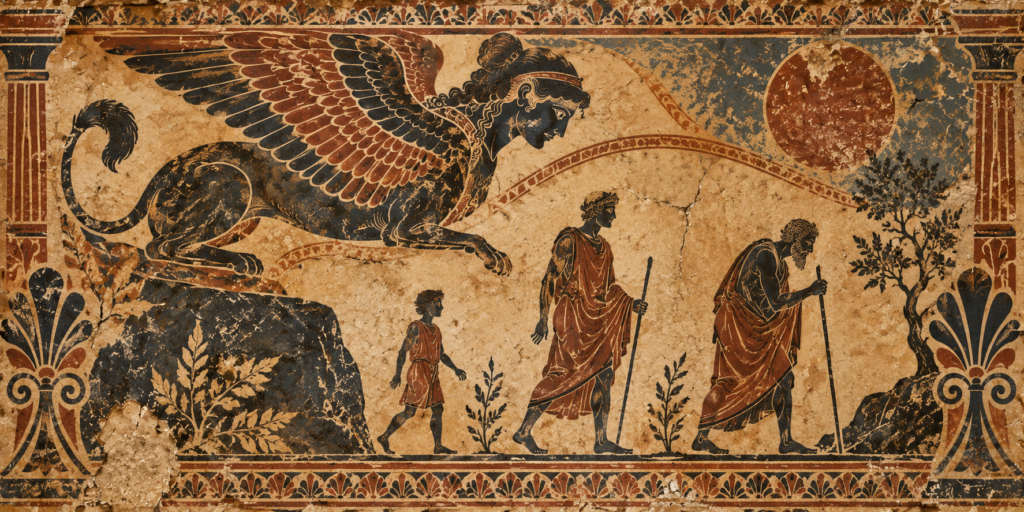
The exact wording of the riddle varies between different versions, but the ancient account preserved in Apollodorus’ Bibliotheca asks what creature has one voice and becomes four-footed, two-footed and three-footed.
Oedipus knew the answer.
A human being.
As babies, humans crawl using both their hands and knees. Adults walk upright on two legs, while an elderly person may use a walking stick as a third point of support.
The version most familiar today usually phrases the riddle slightly differently: what walks on four legs in the morning, two legs at noon and three legs in the evening?
Here, the course of a single day represents a human lifetime. Morning is infancy, noon is adulthood and evening is old age.
This familiar wording should not be treated as one definitive ancient quotation. Greek myths were retold repeatedly, and the surviving versions of the riddle differ.
The important part remained the same. The answer was humanity, and Oedipus was clever enough to recognise it.
What Happened After Oedipus Solved the Riddle?
Once Oedipus gave the correct answer, the Sphinx was defeated.
In the Bibliotheca, she responds by throwing herself from the citadel. Other traditions vary, but the result is the same: Thebes is finally free of the monster.
Oedipus was rewarded with the throne and married Jocasta, the widow of the previous king, Laius.
This should have been his great triumph. Instead, it completed a prophecy that Oedipus had spent years trying to escape.
An oracle had foretold that he would kill his father and marry his mother. Believing the king and queen of Corinth to be his biological parents, Oedipus left them in an attempt to prevent the prophecy from coming true.
On his travels, however, he encountered and killed a stranger during an argument. That stranger was Laius, his real father.
By solving the Sphinx’s riddle and becoming king of Thebes, Oedipus then married Laius’s widow. Jocasta was his biological mother.
There is a particularly cruel irony in the riddle because of this. Oedipus is clever enough to understand a puzzle representing the entire course of human life, yet he knows remarkably little about his own.
His intelligence saves Thebes while simultaneously carrying him towards the fate he has been trying to avoid.
This tension became central to Sophocles’ Oedipus Tyrannus, where the brilliant man who once solved the Sphinx’s mystery gradually discovers the much more horrifying mystery of his own identity.

How Old Is the Story of Oedipus and the Sphinx?
The connection between the Sphinx and Thebes goes back to some of our earliest surviving Greek literature.
Hesiod’s Theogony, probably composed during the eighth or seventh century BC, already describes the Sphinx as a destructive force against the Cadmeans.
Ancient Greek artists also depicted the Sphinx extensively. She appeared on pottery and sculpture, sometimes as a guardian of the dead and sometimes as the dangerous monster familiar from myth.
The story of Oedipus confronting her was familiar to Greek playwrights too. Aeschylus wrote a now-lost satyr play called Sphinx, while Sophocles repeatedly refers to Oedipus defeating the monster in Oedipus Tyrannus.
Interestingly, Sophocles does not give us the famous riddle in the neat form most people know today. The detailed version describing the creature that moves on four, two and three feet survives in later sources such as Apollodorus.
This is fairly typical of Greek mythology. There was no single official book containing the correct version of every myth. Stories were performed, painted, written and retold over centuries, and details changed along the way.
The central idea of this particular story remained remarkably powerful.
The Sphinx asks Oedipus to identify a creature that changes throughout its life, and he correctly answers humanity. Yet while Oedipus understands what a human being is, he has still not discovered who he himself really is.
That turns a clever riddle into something much darker, and helps explain why the story has survived for more than two thousand years.
Get in Touch
What do you think of the Riddle of the Sphinx? Was Oedipus genuinely clever, or was solving it simply another step towards the fate he could never escape?
If you have a favourite version of the story, or another myth you’d like to see covered on MythologyPlanet, get in touch with me at richard@mythologyplanet.com