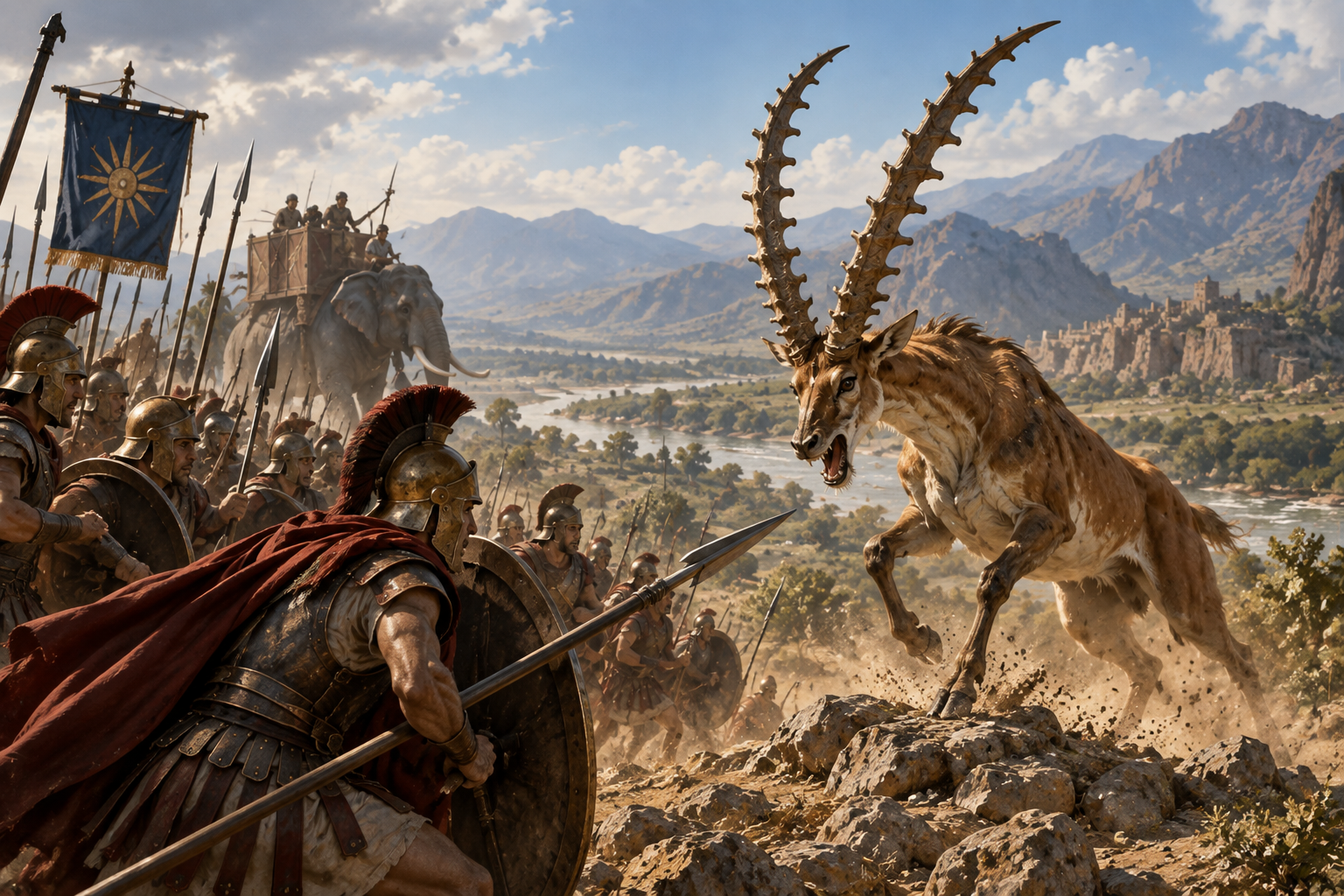
The Aeternae are among the most obscure creatures associated with Greek legend.
According to a story repeated in modern mythology books, Alexander the Great encountered the creatures while campaigning in India. The Aeternae supposedly possessed fearsome, saw-like antlers on their heads, which they used to kill and wound Alexander’s soldiers.
There is just one problem.
The further we look into the story, the stranger its history becomes.
The Aeternae may not be conventional monsters from Greek mythology at all. Instead, they appear to belong to the enormous collection of legends that developed around Alexander the Great and the extraordinary creatures he supposedly encountered in the East.
What Were the Aeternae?
Modern descriptions generally portray the Aeternae as dangerous beasts with bony, saw-toothed projections growing from their heads.
They were supposedly encountered by Alexander’s army while travelling through India, where their unusual natural weapons proved capable of killing and injuring soldiers.
Beyond that, descriptions are frustratingly vague.
Unlike famous Greek monsters such as the Gorgons or Typhon, the Aeternae do not have a familiar Classical myth involving gods and heroes.
Instead, their story is connected with legendary accounts of Alexander’s travels.
That distinction is important.
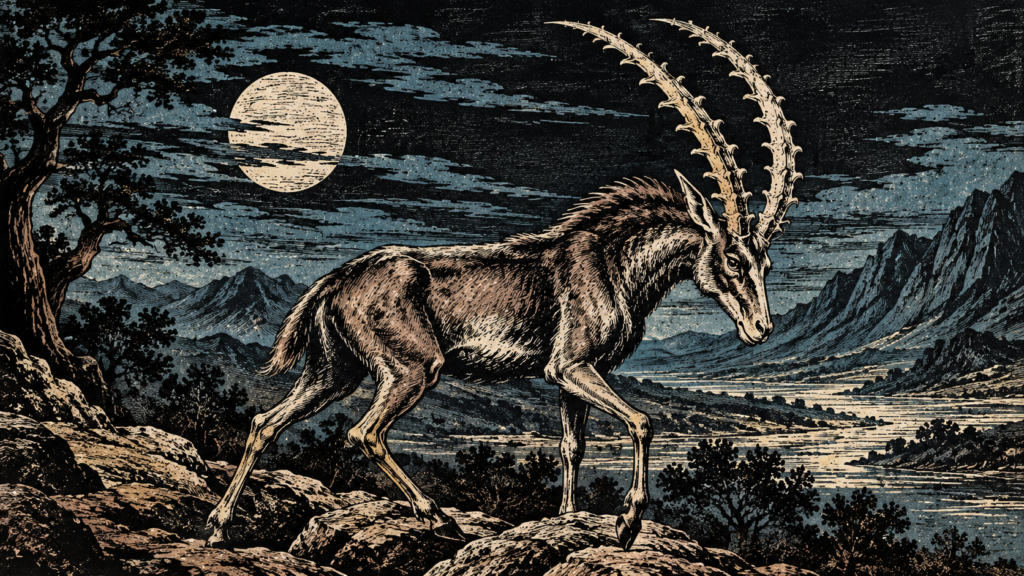
Did Alexander the Great Really Encounter the Aeternae?
The historical Alexander invaded northwestern India in 326 BC, famously defeating King Porus at the Battle of the Hydaspes.
But this does not mean Alexander himself recorded an encounter with monsters called Aeternae.
Stories surrounding Alexander became increasingly fantastic after his death. Over the centuries, the historical Macedonian king became the hero of a huge literary tradition known broadly as the Alexander Romance.
Different versions sent Alexander into strange and distant lands populated by extraordinary peoples, animals and supernatural phenomena. Medieval manuscripts preserved and repeatedly adapted these stories long after Alexander’s lifetime; the British Library, for example, holds numerous versions and adaptations of the Alexander romance tradition.
Explore an Alexander Romance manuscript at the British Library
The Aeternae fit more comfortably into this legendary world than into mainstream Classical Greek mythology.
Although modern reference works regularly associate them with Alexander, identifying an ancient Greek source that actually calls these creatures Aeternae is surprisingly difficult.
So although you’ll often see the Aeternae described simply as “Greek mythological creatures,” it is safer to describe them as creatures associated with the legendary travels of Alexander the Great.
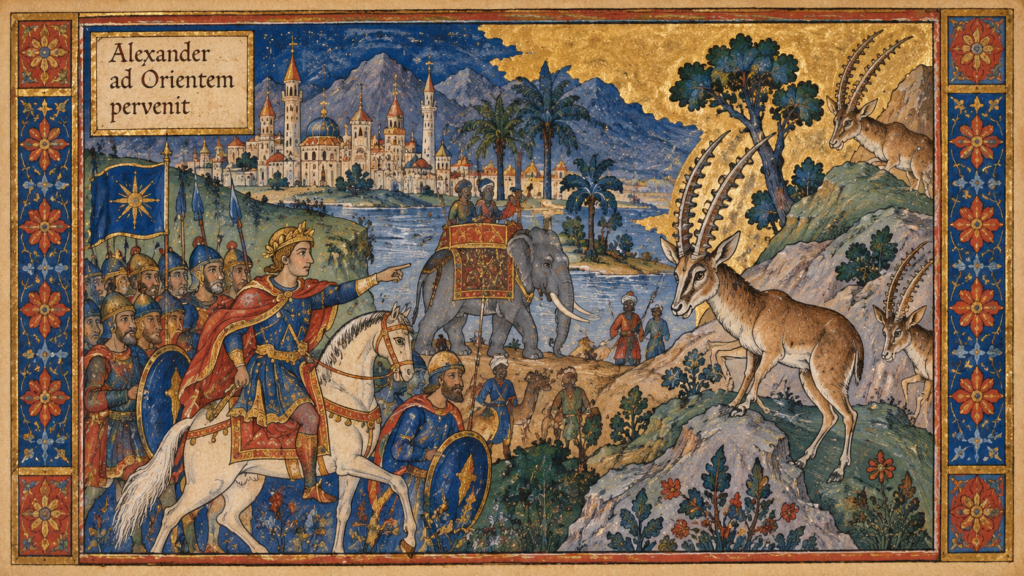
Were the Aeternae Actually Antelope?
This is where things get particularly interesting.
A much older tradition describes Alexander encountering strange antelope-like animals armed with enormous serrated horns.
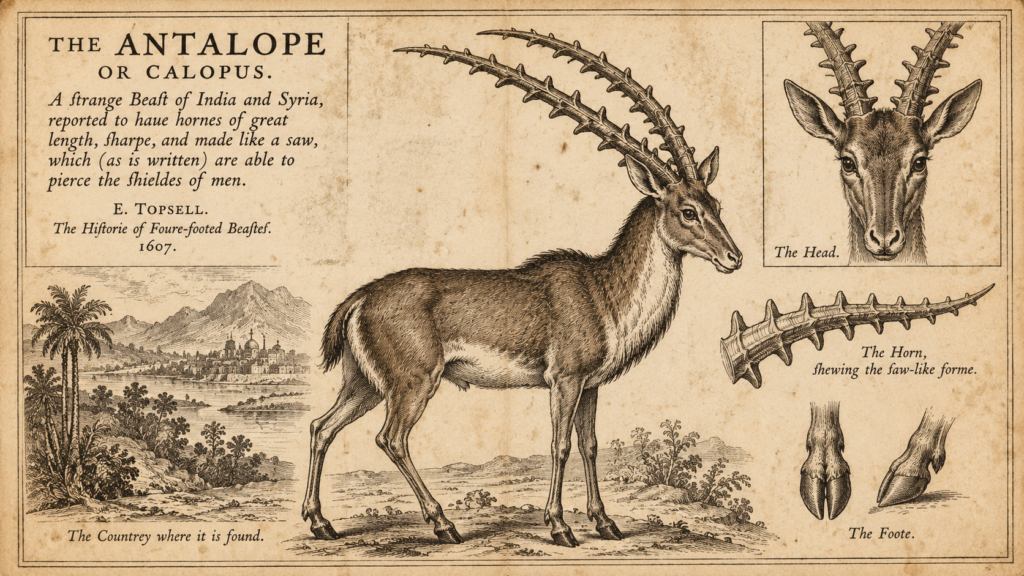
In his 1607 Historie of Foure-footed Beastes, English writer and clergyman Edward Topsell described a creature he called the Antalope, also referring to the Latin Calopus. Topsell’s book collected material from earlier writers, particularly the Swiss naturalist Conrad Gessner. The original 1607 volume survives and has been digitised by the Library of Congress.
Read Topsell’s 1607 book at the Library of Congress
Topsell says the animal was found in India and Syria and resembled a roe deer. Its most extraordinary feature was a pair of extremely long and sharp horns.
According to the Alexander tradition he recorded, the horns were capable of piercing the shields of Alexander’s soldiers.
Most intriguingly, Topsell explicitly describes the creature’s horns as being “made like a saw.”
That sounds remarkably similar to the defining feature of the modern Aeternae.
Rather than imagining the creatures as humanoid monsters covered in bone, as some modern artwork portrays them, there is therefore good reason to consider their relationship with this older tradition of a fantastical antelope with serrated horns.
Exactly how the name Aeternae became attached to the creature, however, remains unclear.

Was There a Real Animal Behind the Legend?
Fantastic animals described by ancient and medieval writers sometimes developed from encounters with unfamiliar wildlife.
An unusual antelope described by travellers far from home could acquire increasingly impressive characteristics as its story was retold. Large horns become enormous horns; enormous horns become serrated weapons capable of cutting branches and piercing shields.
That doesn’t prove the Aeternae were simply misunderstood antelope.
But the resemblance between modern descriptions of the Aeternae and the older Antalope or Calopus tradition suggests that the two stories may be related.
It also demonstrates one of the difficulties involved in researching obscure mythological creatures. Stories can be copied, translated and altered for centuries until separating the earliest tradition from later additions becomes extremely difficult.
What Does the Name Aeternae Mean?
This is another area where we need to be careful.
The previous version of this article stated that the Latin word aeternus meant “vital energy.” We have been unable to find reliable evidence for that translation.
In Latin, aeternus instead relates to something eternal, everlasting or enduring.
However, that doesn’t necessarily explain the creature’s name.
Without a reliable early source explaining why these creatures became known as Aeternae, deriving their name directly from Latin aeternus would be speculation.
For now, the origin of the name is best regarded as uncertain.
So What Were the Aeternae?
The most accurate answer is that we don’t know for certain.
The creatures now called Aeternae are associated with legendary accounts of Alexander the Great’s travels in India and are usually described as possessing dangerous saw-like projections or horns.
But that familiar modern description bears a striking resemblance to an older tradition involving a fabulous antelope whose serrated horns could supposedly pierce shields.
That makes the Aeternae interesting for a different reason.
They show how mythology changes as stories travel.
A strange animal encountered at the edge of the known world can become a legendary beast. The beast is copied into later books, given new names and descriptions, and eventually ends up listed alongside creatures whose origins are much easier to trace.
The Aeternae may be obscure.
But the mystery surrounding them is arguably more interesting than the monster itself.
Get in Touch
Have you encountered another historical source mentioning the Aeternae? We’d particularly love to hear from anyone who has found an early use of the Aeternae name itself.
Let us know in the comments below.
You can also discover more unusual creatures from Greek mythology, including the Kobalos, Taraxippus and Gorgons.
Awesome!